
The Difference Between General Advertising and Direct Response: Proxies vs. Proof
A featured authority article for DMCGResults.com.
Core idea: The real difference is not the medium. It is the standard of evaluation and the burden of proof.
People often think the difference between general advertising and direct response is mainly about media.
It is not.
Direct response is not the same thing as direct mail. And general advertising is not defined by television, print, digital video, or social media.
Both can use almost any channel. Both can target the same audience. Both can support growth.
The real difference is not the medium.
The real difference is what the advertising is expected to do, and how the work is evaluated.
Start with the Standard of Evaluation
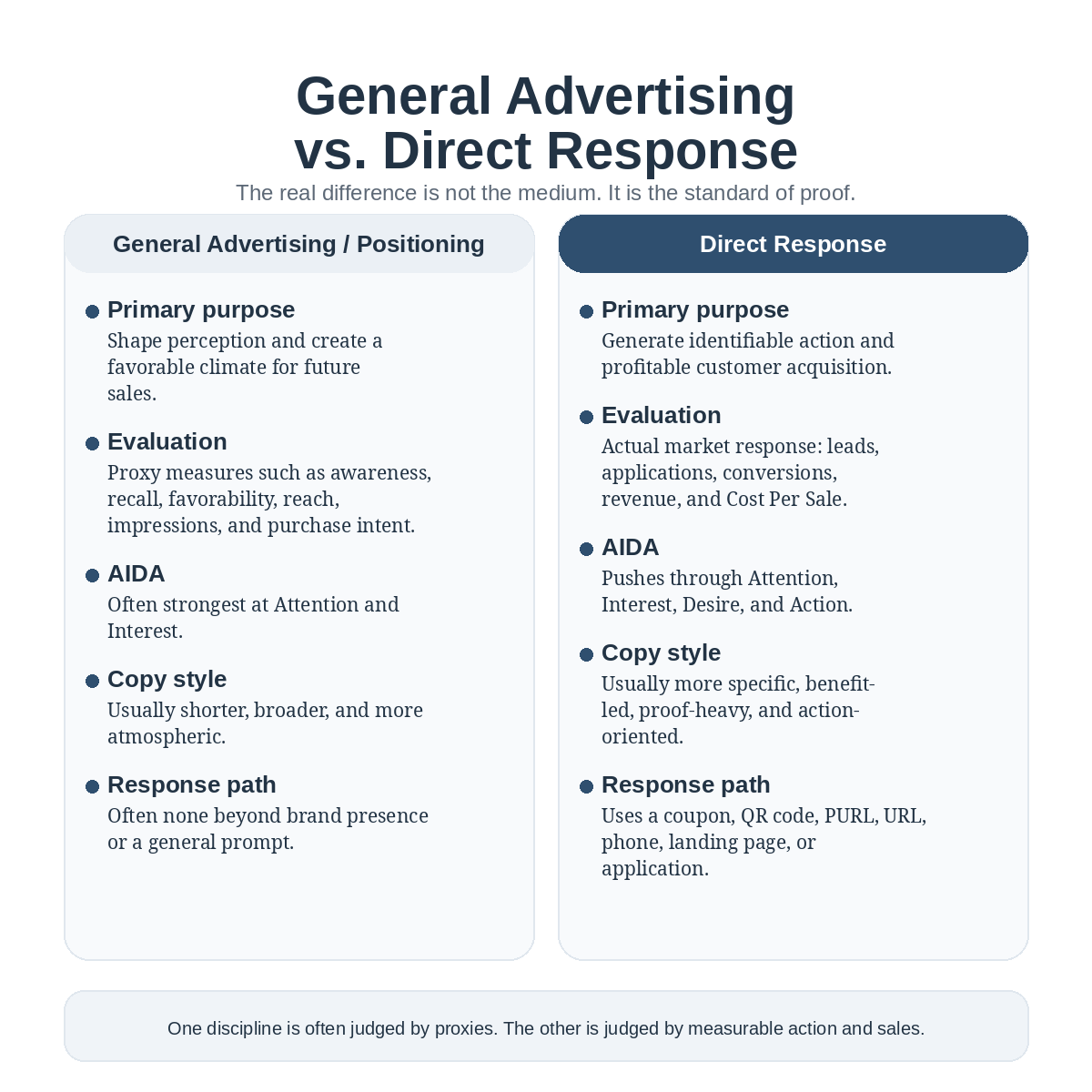
General advertising, also called positioning advertising by many agency professionals, is usually designed to shape perception, build awareness, support preference, and create an environment favorable to future sales.
Direct response is designed to generate an identifiable response from a targeted audience and evaluate that response against business results.
That distinction matters because the two approaches live under different standards of proof.
General advertising is often judged through proxies: unaided recall, aided recall, awareness, recognition, message take-away, favorability, consideration, purchase intent, reach, impressions, frequency, and engagement.
Those measures are not meaningless. But they are still proxies.
Direct response lives under a different discipline. It is judged by what people actually do. Did they inquire? Apply? Call? Click? Request information? Buy? Renew? Convert?
And ultimately, did the spend produce sales at an acceptable Cost Per Sale?
Direct Response Was Never Confined to Mail
This is why I have never agreed with the idea that direct response is a narrow specialty confined to mail.
It never was.
Direct response has always been about placing a message in front of a targeted audience and asking for action. Mail. Print. Broadcast. Space advertising. Inserts. Catalogs. DRTV. Email. Landing pages. QR codes. PURLs. Lead-generation websites. Any medium that can carry a message and invite response can be used for direct response.
Direct response is not a channel.
It is a way of thinking about advertising.
Positioning Matters. Direct Response Simply Asks More of It.
Direct response does not ignore image, trust, or positioning. Quite the opposite.
Professional direct response pays close attention to reputation, emotional comfort, credibility, and brand meaning. It knows those things matter. But it does not stop there.
If the company claims to be trustworthy, direct response asks the product and the offer to prove it.
If the company claims to solve a serious customer problem, direct response asks the message to make that case clearly enough to produce action.
If the positioning is sound, direct response asks whether it can work in the real world.
That is why I think many people misunderstand the relationship between general advertising and direct response. Direct response does not reject positioning advertising. It usually does positioning work plus more.
It builds image. It frames the problem. It explains the product. It gives reasons to believe. It asks for a response. And it begins a measurable relationship.
Why AIDA Still Matters
Some readers may think a discussion like this ignores persuasion theory. It does not. In many ways, direct response takes persuasion more seriously.
General advertising may do excellent work at Attention and Interest. Sometimes Desire as well.
Direct response asks a harder question: Why stop at AI when you can go on to AIDA for the same advertising cost and prove the positioning works in the marketplace?
A direct-response ad is usually built to move the prospect farther along. It does not just create awareness. It tries to convert awareness into interest, desire, and action.
That is one reason direct-response ads often need more copy.
What the Ads Look Like in the Real World
A pure image ad may rely on atmosphere, symbolism, short copy, reputation cues, and broad emotional suggestion.
A direct-response ad usually has more work to do.
It may still use reputation, leadership, financial strength, or emotional reassurance. But then it goes deeper. It names the product. It explains the benefits. It reduces uncertainty. It gives the prospect reasons to believe. It often targets a more specific audience. And it asks for a response now.
That response might come through a coupon, a business reply card, a phone number, a QR code, a PURL, a landing page, an application path, or a request for more information.
Why? Because direct response is not merely about leaving behind a favorable feeling.
It is trying to begin a measurable relationship.
A Life Insurance Example Makes the Difference Clear
A general life insurance advertisement may feature the company name and logo, highlight leadership, financial strength, heritage, and reputation, and reassure readers that the company will be there when families need it. The copy may be short. The impression may be warm and credible. But the ad often stops there.
A direct-response life insurance ad may use some of those same credibility signals, but then it keeps going. It names the product. It states who is covered. It lists benefits and coverage ranges. It explains important terms. It reduces the prospect's uncertainty. It gives a reason to respond now. And it includes a way to do so immediately - by card, QR code, landing page, phone number, or application form.
One ad supports a positive impression. The other asks for the impression to prove itself through action.
Customer Experience Still Decides the Long Run
In many service businesses, advertising can support a reputation, but it cannot manufacture one for long. Real reputation is built in the customer experience itself: product quality, service quality, fulfillment, problem resolution, and word of mouth.
Messaging can support good service. It cannot overcome poor service forever.
That does not weaken direct response. It strengthens it. Direct response does not only ask whether the message sounded good. It asks whether the offer, product, and customer experience can hold up when real prospects are asked to act.
Why This Matters More Now
Much of modern marketing has been pulled in this direction. Lead-generation websites. E-commerce. Customer databases. CRM systems. Performance media. Customer intelligence. Segmentation. Commerce platforms. These all reinforce the direct-response philosophy because they push marketers toward measurable action and economic accountability.
Even when the industry uses softer language, the center of gravity keeps moving toward proof.
The largest agency groups have spent years buying data, commerce, CRM, precision marketing, and customer-transformation capabilities because that is where measurable growth now lives.
That does not mean all digital advertising is direct response. Some digital work is still pure reach, image, entertainment, sponsorship, or cultural signaling.
But a high percentage of modern digital marketing operates under direct-response logic even when the industry does not call it that.
The Core Difference
At its best, direct response does not force a company to choose between building image and building paying relationships.
It tries to do both.
It takes the same advertising investment and asks for more. Build the image. Support the positioning. Make the promise credible. Generate a response. Identify the prospect. Start the relationship. Convert the expense into customer acquisition.
That is why direct response can be such a powerful discipline. It asks advertising to do more economic work.
General advertising, or positioning advertising, still matters. But its evaluation usually remains indirect. It is often judged by what people say they remember, feel, recognize, or intend.
Direct response asks what they actually did.
That is a higher burden of proof.
Conclusion
That is why I still believe the difference between general advertising and direct response is one of the most important distinctions in marketing.
One discipline is often evaluated by proxies.
The other is ultimately evaluated by sales.
One is often satisfied when the message is noticed, remembered, or liked.
The other is not finished until the message produces action at an acceptable Cost Per Sale.
That is the difference.
And that is why direct response is not simply another advertising tactic. It is a broader, tougher, and more accountable standard for what advertising should be expected to accompli