
The Response Rate Trap: What Serious Direct Response Marketers Measure Instead
If direct response is built around a measurable response, why shouldn't response rate be the main KPI?
It sounds logical.
Mail 100,000 pieces. Measure response. Compare results. Pick the winner.
That thinking is common. It is also incomplete.
A campaign can produce an impressive response rate and still disappoint financially. Another campaign can pull a lower response rate and produce better customers, stronger profit, or more durable growth.
Response matters. But response rate alone is not enough.
The real scorecard is financial performance.
Response Rate Measures Activity, Not Value
Response rate tells you how many people reacted.
It does not tell you:
what it cost to generate those responses
how many converted to sales
average order value
gross margin
refund or cancellation behavior
repeat purchase potential
retention value
servicing burden
long-term profitability
That is why the response rate can become a trap.
It feels precise because it is a number. But it may be measuring the wrong thing.
Direct Response Is a Discipline, Not a Channel
Direct mail has long been one of the cleanest testing environments in marketing.
You can isolate:
lists
offers
formats
timing
copy approaches
packages
You can compare controls against challengers. You can scale what works.
That discipline taught an important lesson:
A higher response rate does not automatically mean a better campaign.
That is especially true in lead generation.
High lead volume does not guarantee profitable conversion.
For example, contests often create higher response rates, but many consumer markets see weaker lead-to-sale conversion, making the campaign less profitable than it first appears.
Lead quality is shaped by the offer, targeting, and market selection.
Sometimes a lower-responding package attracts better buyers.
Sometimes a high-response offer attracts weaker customers.
Sometimes the response winner collapses when rolled out beyond the best names.
The lesson applies just as much to:
digital lead generation
paid search
e-commerce funnels
call-center acquisition
omnichannel campaigns
True digital acquisition marketers should care about this as much as direct mail marketers do.
The Better KPI: Cost Per Sale
Many organizations need a governing number that links marketing performance to financial results.
That number is often Cost Per Sale, or CPS.
Clarifying Cost Terms: CPS, CPC, and CPA
Different industries use acquisition-cost terms loosely. That is why the terms should be defined before they guide budget decisions.
Cost Per Sale (CPS) measures the cost of producing a specific sale. It is usually tied to a product, service, offer, campaign, or product line.
Cost Per Customer (CPC) measures the cost of acquiring a customer. CPC also ties directly to sales outcomes. But it is often used more as a corporate marketing number for the overall acquisition budget.
Cost Per Acquisition (CPA) is the most flexible term. That also makes it the most dangerous. Some companies use CPA to mean the cost to acquire a new customer. Others use it to mean the cost to generate a sale, lead, trial, subscription, or account.
CPA should not be used unless everyone knows what is being acquired.
In practical terms, CPS often depends on the customer-acquisition calculation. You cannot judge the cost of producing a sale unless you know what it costs to acquire, convert, and retain the customer behind that sale.
Formula:
Cost Per Sale = Total Acquisition Cost ÷ Sales Generated
For customer acquisition work, the related corporate number is:
Cost Per Customer = Total Acquisition Cost ÷ New Customers Acquired
These numbers change the conversation.
Instead of asking only, "How many people responded?" leadership can ask, "What did it cost to produce the sale or acquire the customer?"
That is the stronger management question because it connects marketing activity to money.
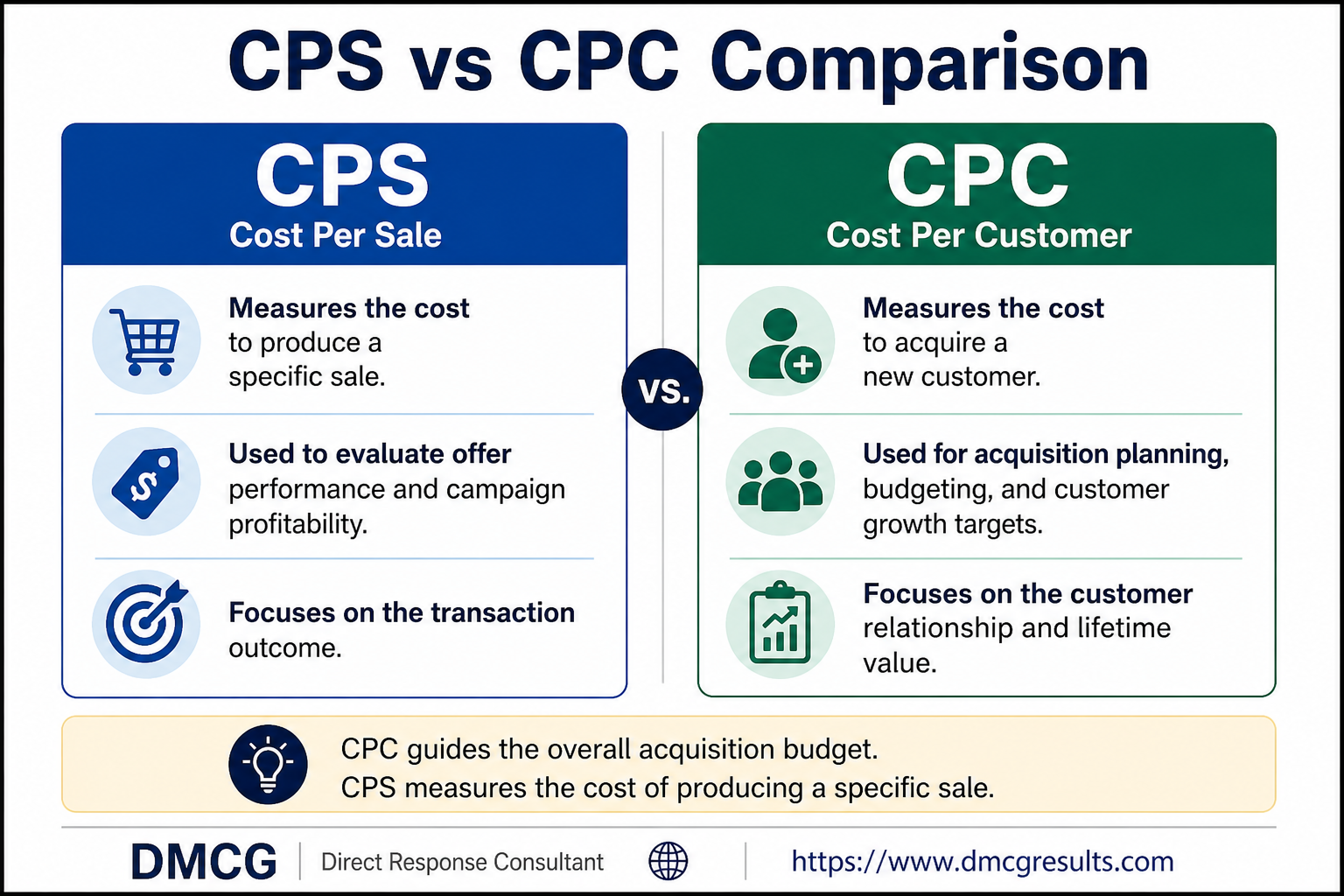
CPC guides the overall acquisition budget. CPS measures the cost of producing a specific sale.
The Governing Number: Allowable Acquisition Cost
Once you understand your economics, you can define an allowable acquisition cost.
For a specific product, service, or offer, that number may be an allowable Cost Per Sale. For broader corporate acquisition planning, it may be an allowable Cost Per Customer.
Either way, the allowable sets the maximum amount the business can spend to produce the sale or acquire the customer while still meeting profit goals.
This number is often shaped by gross margin, repeat purchases, renewal rates, refund risk, sales expense, fulfillment cost, customer service burden, retention value, and payback timing.
You do not need to reveal the entire model publicly.
But management needs enough discipline to know what a new customer is worth.
Once leadership accepts the allowable, budget conversations improve.
Your CEO and financial officer can connect marketing spend to:
expected customers
margin contribution
growth potential
Lead Generation Requires One More Step
Many companies generate leads first and sales later.
In those systems, Cost Per Lead alone can mislead just as badly as response rate.
A cheap lead that never converts is expensive.
A higher-cost lead that converts well may be a bargain.
The allowable Cost Per Lead should be built from the allowable Cost Per Sale.
Example:
If your allowable Cost Per Sale is $100, and 10% of leads convert to sales:
Allowable CPL = Conversion Rate × Allowable CPS
Allowable CPL = 10% × $100 = $10
Now your lead goal is tied to customer economics, not wishful thinking.
You Can Translate CPL Into the Required Response Rate
Once you know the allowable CPL, you can work backward into the response rate required for the campaign to make sense.
Example:
Campaign cost: $50,000
Pieces mailed: 100,000
Allowable CPL: $10
Required leads:
$50,000 ÷ $10 = 5,000 leads
Required response rate:
5,000 ÷ 100,000 = 5%
That 5% response rate now has meaning.
It is not a trophy number. It is the response required to hit the allowable.
In many direct mail prospecting markets, 5% would be exceptional. Actual ranges vary by offer, audience, and market conditions.
If the required response is unrealistic at rollout scale, the campaign concept should probably be reworked before testing.
Do Not Let a Small Test Fool You
Reduced test quantities can limit risk.
That is useful. But small-test economics alone should not govern a rollout decision.
If you test 10,000 pieces but hope to mail 250,000, the real question is whether performance can hold as scale expands.
A practical progression may look like this:
Initial test: 10,000
Expansion test: 50,000
Broader test: 100,000
Full rollout: 250,000
At each stage, compare results to the allowable CPS.
This helps prevent false confidence created by a small winning cell that cannot scale.
The Goal Is Profitable Growth, Not Maximum Profitability at the Expense of Growth
Direct mail often makes it easy to improve short-term profit by mailing only the best prospects.
That can look smart on a spreadsheet.
But it can also limit growth.
For many healthy companies, the better goal is maximum growth within the allowable CPS. The goal is not maximum short-term efficiency.
If you can profitably mail deeper into the universe, that expansion may create more long-term value than protecting only the highest-profit names.
Why?
Because new customers create future opportunities:
repeat purchases
cross-sell revenue
renewals
referrals
a larger customer base
The highest-profit slice is not always the best growth strategy.
When Penetration Becomes the Limit
There is still a limit.
As a company or product line matures, the best prospects are usually the ones who respond first. Deeper penetration usually requires more frequent and more targeted appeals. As unconverted prospects become harder to convert, response rates weaken, and Cost Per Customer rises.
At that point, the allowable CPC becomes a hard budget boundary.
If response keeps declining and CPC rises to the allowable level, the company has reached the practical limit of that product or market universe.
Beyond that point, additional spending does not produce disciplined growth. It simply buys deeper economic exposure that the business has already decided it cannot afford.
The right move may be a major product revision, a stronger offer, a different market, or a new acquisition strategy.
The goal is not to keep expanding just because the budget is available. The goal is to know when the current product or market has reached its peak.
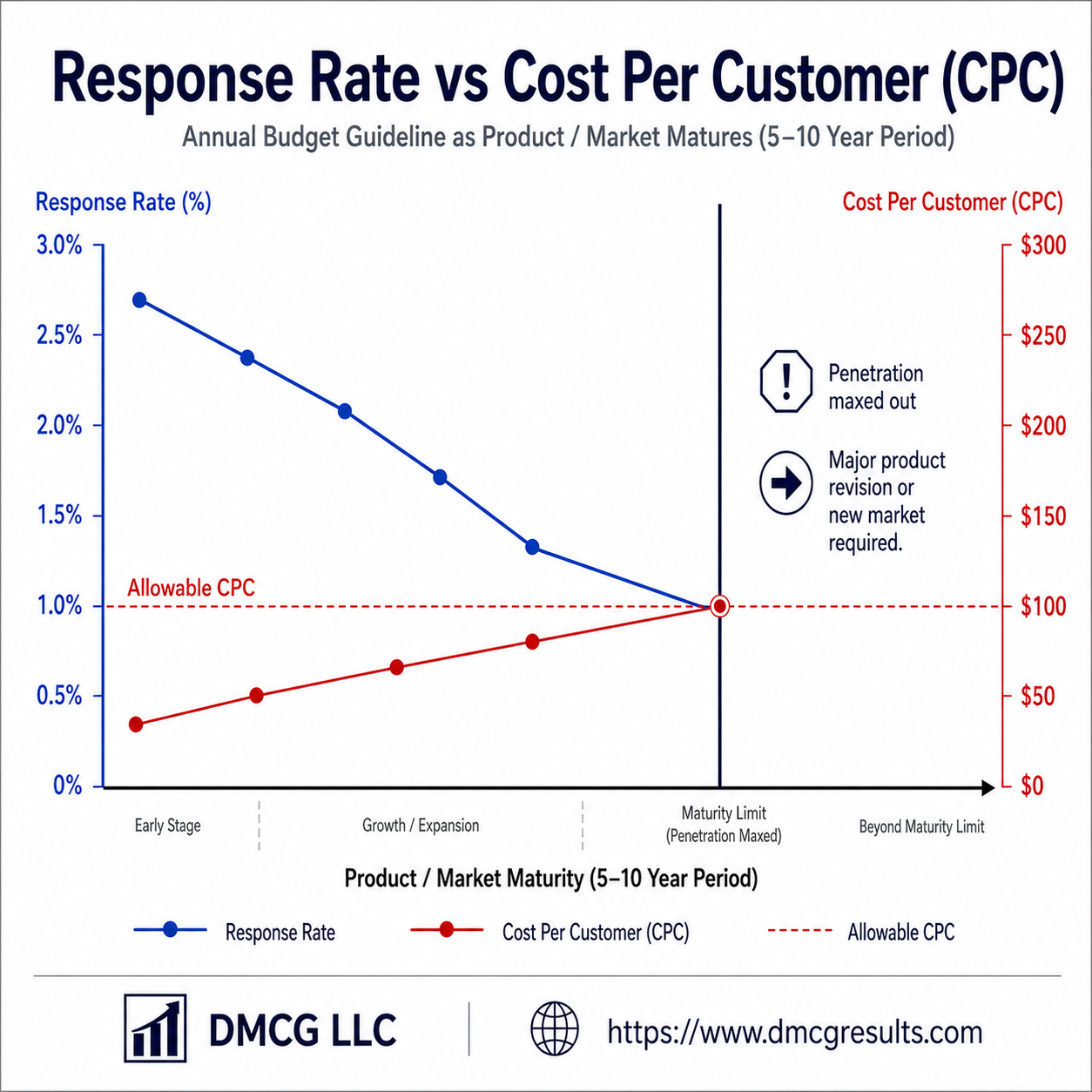
Product profitability declines as penetration deepens.
Where Allowables Should Be Used
Allowable CPS can guide:
direct mail
paid digital media
search campaigns
lead generation
call-center acquisition
affiliate programs
omnichannel systems
budget planning
rollout decisions
management presentations
outcome testing
multivariate testing
Advanced organizations may need more than one allowable.
Different entry offers often produce different lifetime values.
How customers enter the relationship affects how much you can afford to spend to acquire them.
That is why a complete relational or transactional database matters.
Without accurate customer history, allowable math becomes guesswork.
That is a customer-driven marketing discipline.
Response Rate Still Matters
Response rate is not useless.
But it should not be the governing KPI.
The governing KPI is the number that tells you whether the campaign can acquire customers profitably and scale safely.
In many direct response systems, that number is the allowable Cost Per Sale.
Final Thought
Response measures activity.
CPS and CPC reveal whether that activity creates economic value.
That is why serious direct response decisions should not be governed solely by response rate.
They should be governed by the allowable economics that show whether a sale, customer, product line, or market can still grow profitably.