
Does Your Marketing Budget Feel Like It Was Pulled Out of Thin Air?
Why achievable, profitable market demand should determine marketing investment—not last year’s communications and media budget.
Most companies establish their marketing budgets in reverse order: they approve a communications and media spending limit before determining how much profitable growth the market can reasonably deliver.
They begin with last year’s spending, company revenue or a percentage of the total corporate budget. Marketing proposes an increase. Finance pushes back. The final number usually reflects what management can tolerate—not the amount of profitable growth available.
The process disconnects two decisions that should be inseparable. Corporate leadership sets a growth goal and a marketing spending limit, often with little marketing involvement. Marketing is then expected to develop a strategy that fits the approved number and still achieves the corporate goal. The sequence should begin by determining what profitable sales volume the market can reasonably deliver. Only then should the company approve the investment required to capture it.
A 2025 Deloitte Digital survey shows how common this is. Among 1,395 marketing leaders at large and midsize U.S. companies, 25% said their annual marketing budgets were based on company revenue, 21% started with a change from the previous year, and 15% received a percentage of the total corporate budget.
Only 9% said a return-on-investment threshold was the primary basis for the budget.
Deloitte concluded that at least 61% of marketing budgets were based on enterprise revenue, the corporate budget or prior spending—not marketing performance or potential return.
Companies describe themselves as customer-driven and data-driven. Yet most still establish one of their most important growth investments using numbers that may have little connection to customers, product profitability or available market opportunity.
That is the problem.
1. The Problem: Marketing Is Expected to Deliver a Goal It Did Not Help Establish
A marketing budget should fund the creation of profitable revenue.
That sounds obvious. But it is not how many companies plan.
Corporate leadership establishes a growth target. Finance develops an expense plan. Marketing receives a budget. The marketing team then creates strategies and tactics intended to produce the required sales.
The sequence appears logical because it is familiar. Economically, it may be indefensible.
Last year’s marketing expense does not tell management how much profitable demand exists this year. A percentage of company revenue does not reveal what it costs to acquire a sale of a particular product. An industry benchmark says nothing about the company’s margins, qualified market, competitive position or ability to fulfill its customer promise.
The final budget may be comfortable, but it is still artificial.
The deeper problem is that many companies define marketing too narrowly. Marketing is treated as the department responsible for communications, creative development and media planning.
By the time marketing receives an assignment, other executives may already have decided what the company will sell, how it will be priced, how much it must grow and how much marketing may spend.
Marketing is left to make the story persuasive. That is not marketing leadership. It is communications implementation.
Marketing’s higher function is to determine how the company will create, acquire, deliver and retain profitable customer value. That requires involvement in market selection, product development, pricing, acquisition economics, sales conversion, fulfillment, customer service and the customer experience.
Every one of those functions affects whether the advertising promise can be delivered profitably.
When marketing is excluded from them, growth planning becomes disconnected from market reality.The company may demand 10% growth without knowing whether enough qualified prospects exist, whether the product can support the required acquisition cost or whether operations can serve the additional customers.
Marketing cannot create a strategy that makes an impossible goal achievable. It can only disguise the gap with optimistic assumptions.
I confronted this problem more than 40 years ago while working at William Cook Advertising. I wrote a plan for Winn-Dixie titled “A Reversal of the Marketing Strategy.” The premise was that the requested sales goals were not reasonably achievable through the marketing efforts being proposed.
The plan was not well received by many people in the agency. The CEO understood it.
The objection was predictable. Agencies are normally rewarded for accepting a client’s sales goal and recommending activity—not for questioning whether the goal has a defensible connection to the market.
The same dynamic exists inside companies. Historical budgets survive because they are easy to defend. Finance gains predictability. Marketing protects its prior allocation. Leadership avoids confronting whether the growth objective is achievable.
The process can be rational for every participant while remaining irrational for the business.
Modern analytics have not solved this problem. They can report impressions, leads, conversions, attributed revenue and channel return. They can help allocate a predetermined budget more efficiently.
But better allocation does not prove that the total budget is right.
A company can optimize every campaign inside an economically irrational plan.
Fixed budgets also create damaging behavior. Profitable programs stop when their allocations are exhausted. Weak programs survive because departments protect their shares. Testing is cut because it reduces current-period efficiency. Managers spend unused funds because they fear losing them the following year.
The strategy begins serving the budget instead of the budget serving the strategy.
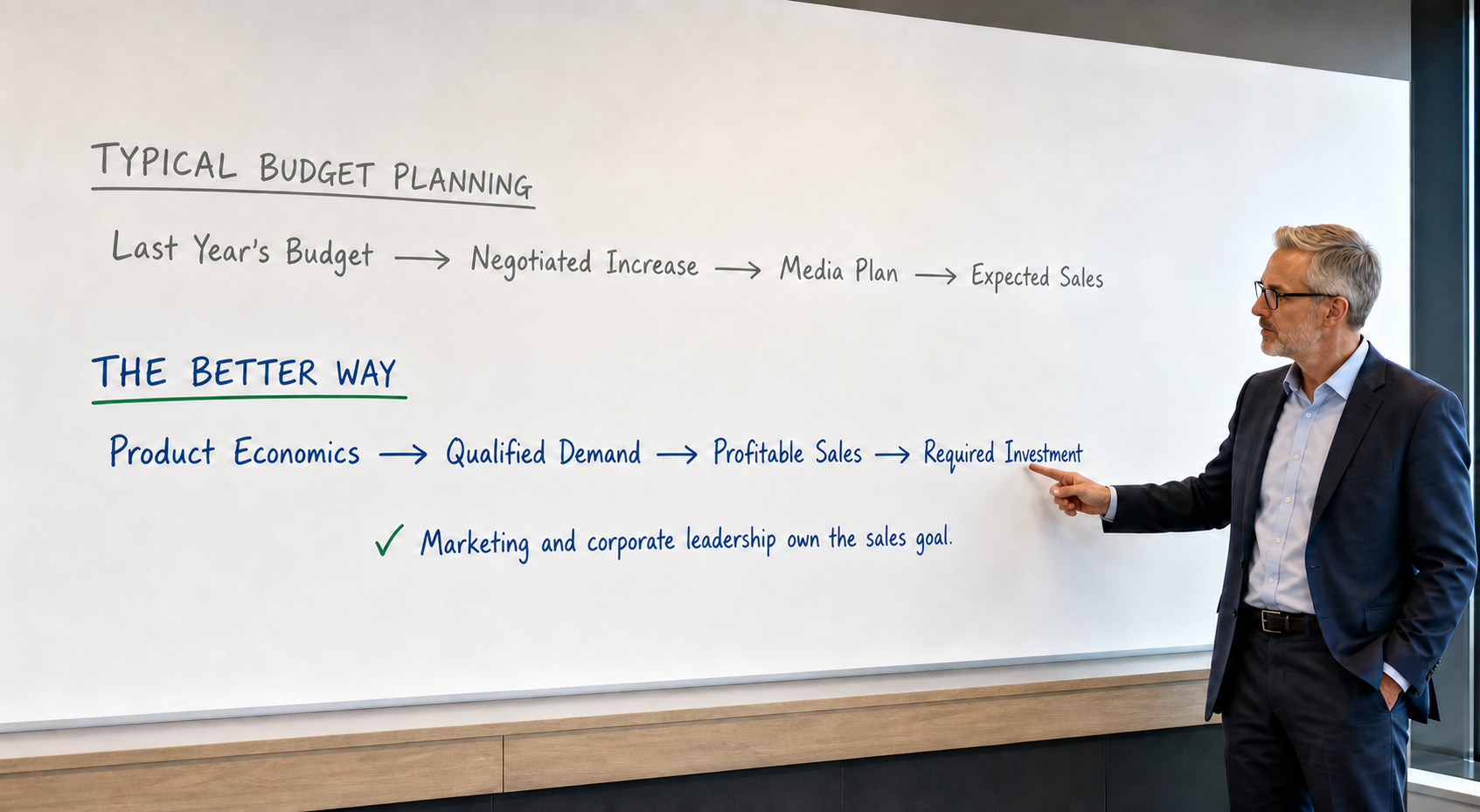
Traditional budgeting starts with last year’s spending. Market-first planning starts with product economics and qualified demand.
2. The Solution: Determine Profitable Growth Before Establishing the Acquisition Budget
I experienced a different system at National Liberty in 1982 and 1983. National Liberty was a 100% direct response company with no external sales force. Its insurance products were sold directly to consumers, off the page, through the direct mail, print, television and telephone channels available at the time.
As director of marketing for the Veterans business, I was not responsible only for advertising. I worked with two product managers and had responsibility for new-product development, creative, media, direct response television, operations, fulfillment, growth and profitability.
I used internal creative teams, outside freelancers and nearly 10 major direct response agencies, including Grey Direct and Tatham-Laird & Kudner. I had broad operating authority and direct profit-and-loss accountability.
The company did not give me an arbitrary acquisition budget and tell me to live within it. I could obtain essentially any amount I could invest profitably.
My responsibility was to maximize new-customer volume within the product allowables—including the cost of testing.
That difference changes the entire planning process.
National Liberty began with the lifetime economics of the average product sold. It did not begin by assigning speculative value to everything the customer might buy in the future.
Those product economics established the allowable marketing investment. Based on the history of our controls, we projected response, conversion, premium revenue and marketing cost by product, channel and season.
Some channels performed better than others. Some tests succeeded and others failed. Individual programs could fall short if the annual product economics remained acceptable.
The governing question was not whether every activity won. It was whether the complete acquisition portfolio produced the required annual economics.
I once asked National Liberty’s president at the time why we did not accept break-even—or even a small loss—to acquire a new customer. We could cross-sell additional products later or increase premiums by selling higher benefits.
His answer was immediate:
“That’s why so many of those companies went out of business.”
I never forgot it.
National Liberty would gladly earn additional value from an existing customer. But it did not use hoped-for cross-sales to justify an uneconomic initial acquisition. The product sold had to support its own marketing cost.
Future customer value was upside. It was not permission to lose money today.
That discipline is especially important now. Customer-lifetime-value models can include renewals, cross-sales, upgrades and future engagement. The mathematics may look precise even when the future behavior is speculative.
Product lifetime economics impose a harder standard: Can the product being sold repay the investment required to acquire it?
Once that question is answered, marketing can help establish an achievable corporate growth plan.
The correct sequence is straightforward:
Determine the lifetime profitability of the average product sold.
Identify the qualified market and the amount of reachable demand.
Evaluate response, conversion, seasonality and channel capacity.
Confirm that product, fulfillment and service can deliver the customer promise.
Establish the allowable acquisition investment.
Forecast the sales volume available within those economics.
Develop the creative strategies and tests required to reach that volume.
Calculate the investment the company must make.
Verify whether the promised revenue and profit were produced.
Only then does the acquisition budget become rational.
Corporate growth should therefore not be handed to marketing as an unsupported percentage. Marketing must first determine how much qualified demand the company can acquire, at what cost and within which product economics.
That analysis establishes an achievable growth range. Leadership can then fund it, build additional capabilities or revise its expectations.
This is not an argument for an unlimited marketing blank check.
Staffing, technology, research, brand development and corporate communications still require their own objectives and controls. Cash, operational capacity and risk also matter. Allowable-driven investment applies most directly to variable customer-acquisition spending and the tests required to improve it.
For a direct response business, the application is immediate. Establish the allowable for each product. Test offers, creative executions, audiences and channels against measurable response, conversion, revenue and acquisition cost. Continue investing—and expand volume—as long as the available market can produce additional customers within the allowable. Reduce or stop spending when it cannot.
The system I knew was built for direct response, where sales and acquisition costs could be measured directly. But its governing discipline can be adapted to other marketing strategies. The measures and time horizons may differ, yet companies can still connect investment to product economics, reachable demand, fulfilled sales and profit instead of beginning with an arbitrary spending limit.
It is more disciplined than a fixed budget because it establishes both permission to invest and a stopping rule.
If another million dollars can acquire additional customers within the allowable, withholding the investment sacrifices profitable growth. If the qualified market is exhausted or the economics no longer work, additional spending should stop—regardless of how much money remains in the annual budget.
National Liberty’s system was not technologically advanced by today’s standards. Most circulation came from response files. Forecasts relied heavily on historical controls. Complex mail packages began as handmade layouts. Our telephone teams supported direct mail and television responses.
But the management system connected the essential decisions: product economics, market capacity, creative, testing, acquisition investment, fulfillment and profitability.
The company later lost that operating focus. Its direct-insurance business broadened into property-and-casualty products, including automobile insurance. By 1996, Providian reported that annualized sales in its direct-insurance operation had fallen by nearly one-third. Automobile losses contributed to lower earnings. The insurance business was sold the following year, and the National Liberty and Veterans Life entities were eventually absorbed through merger.
A buyer can acquire products, policies, customer files and legal entities without preserving the management system that created their value.
That is the warning for today’s leaders.
Marketing cannot be accountable for profitable growth if it controls only messages and media. It needs a place in the company’s highest-level decisions because growth depends on the complete product-to-customer system.
The final question is not, “How much more marketing spending can management tolerate?” It is this: How much profitable growth can our marketing system produce—and what investment, authority and operating capability will it take to capture it? Answer that question first. Then set the budget.
Sources
Marketing-budget statistics: Deloitte Digital, 2025 Marketing Investment Trends.
Providian direct-insurance results and sale: Providian Corporation 1996 annual report.