
How Long and How Often Should You Mail Your Leads?
A prospect becomes something different the moment that person responds to an offer.
Before the response, we may know quite a bit about the individual. We may know age, income, geography, occupation, buying characteristics, interests, credit history, or dozens of other variables. Those characteristics may make the person look very much like one of our better customers.
But we still do not know whether that person is interested in what we are selling.
A response changes that.
The individual has now demonstrated some degree of interest. That makes the name a lead and, for a period of time, potentially more valuable than another name selected from the general prospect population.
The questions are: How often should we contact that lead? And how long should we continue treating that person as a lead?
The answers are related.
Response Recency Is Often the Strongest Conversion Predictor
Direct marketers have understood the importance of recency for decades. People who have acted recently generally respond better than people whose last action occurred much earlier.
A BookBinders Book Club teaching case illustrates the pattern. Among customers offered a new title, the most recent purchase decile responded at nearly 18%, while the least recent decile responded at about 2%. Those were customers rather than unconverted leads, so the percentages should not be applied directly to a lead file. The useful point is behavioral: the predictive value of a prior action generally diminishes with time.
That is exactly what happens to a lead.
Someone who requested a quote last week has given us considerably more current information about interest than someone who requested the same estimate nine months ago. That does not mean the nine-month-old lead is worthless. It means the two names should not automatically be treated as if they were equal.
Not All Leads Are Equal
Recency is only part of the issue. What caused the person to become a lead in the first place?
Someone who asked for a price quote is different from someone who downloaded a free report. Someone who accepted a free three-month trial may be different from someone who entered a sweepstakes. A person who completed a detailed questionnaire may tell us considerably more about purchase intent than someone who responded to a very low-commitment offer.
So I would not build one lead file and assume every name in it has equal value.
The offer that produced the response is another critical factor in converting a lead to a sale.
Each lead-generating offer should establish its own history. How many people respond? How many become customers? How quickly do they convert? What additional products or offers can logically be presented? How long does the lead remain economically productive?
The business must learn what a lead from each source is actually worth.
A Lead File Reconstitutes Itself Continually
I look at a lead file as a living population.
New leads continuously enter at the top. Existing leads become progressively older. Some convert to customers. Others continue through increasingly older recency segments. Eventually, some cease performing like leads and are returned to the general prospect population.
Prospects become leads. Leads age. They either become customers or eventually return to prospect treatment.
That creates a different mailing problem from simply selecting names for a campaign.
In theory, responding to a lead immediately takes maximum advantage of recency. In practice, producing very small quantities every day can increase production, handling, and postage costs substantially. The most responsive mailing is not necessarily the most profitable mailing.
For many businesses, one or two scheduled lead drops a month may produce better total economics than numerous tiny drops. The company must balance recency against cost. As with almost any direct-response decision, the incremental sales from smaller, more frequent drops can be tested against their added production and postage costs.
The Newest Leads Can Help Carry the Older Leads
This is where lead-file rotation becomes a matter of judgment.
Suppose a company mails twice each month. Each mailing may contain the newest leads received since the previous drop, along with progressively older lead segments that are still considered convertible. The newest names should generally respond at the highest rate. Older names will usually respond at lower rates.
But an older lead segment should not automatically be removed simply because it rises above the allowable cost per sale (CPS) when measured by itself.
The decision requires a three-way comparison: recent leads, aging leads, and the best available prospect segments.
An older lead group may no longer perform as well as the newest leads and may have a CPS somewhat above the allowable on its own. Yet it may still respond at a higher rate than even the top tenth percentile of the general prospect file. Replacing those names with weaker prospects could reduce sales and make the overall mailing less efficient. The objective is to acquire sales at the allowable cost, on average, so the company can meet its growth and profitability requirements.
That does not give the aging segment a free pass. The amount by which its CPS exceeds the allowable must be small enough that the combined lead mailing still achieves the allowable CPS. Management must also compare the segment with the response and CPS expected from the best available prospect names. If the aging leads remain the stronger economic choice and the combined mailing stays within the allowable, they still belong in the rotation.
The aging segment loses its special lead status when either condition fails: the combined mailing can no longer achieve the allowable CPS, or the best available prospect segment offers stronger expected economics. The names may still qualify for future prospect offers, but they no longer deserve the frequency or treatment reserved for leads.
That is why the stopping point depends on what you would mail instead. Everything requires judgment.
A Useful Practitioner Example
A 2026 practitioner example reported by the chief data officer of Data Decisions Group shows how quickly responder non-converter economics can deteriorate. The figures below are observed results from one program, not a universal benchmark, but they illustrate why recency bands must be measured separately.
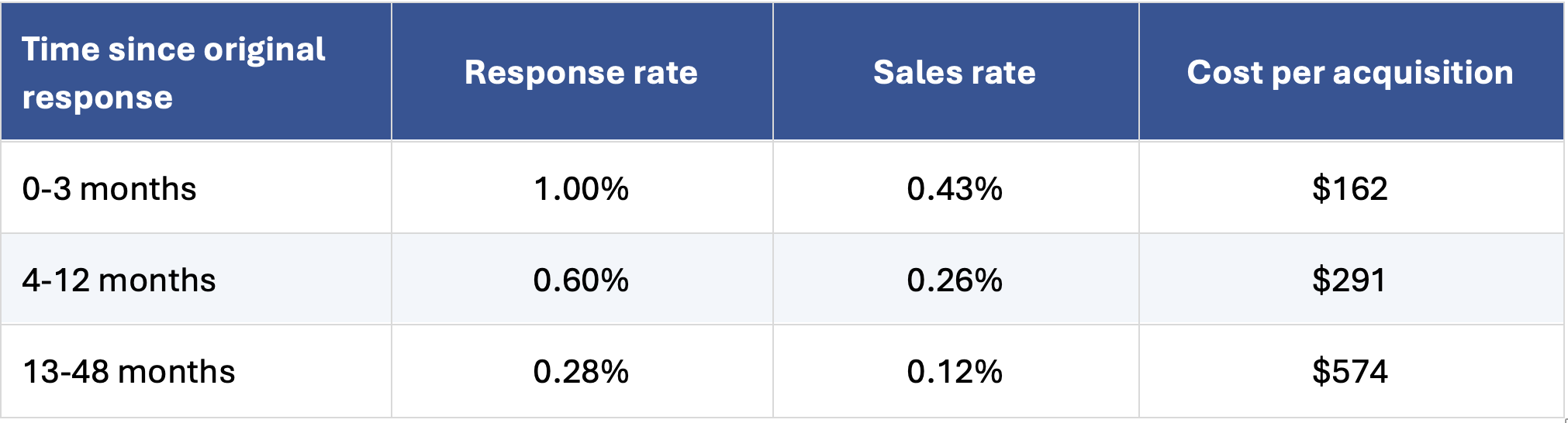
Source: David Schneider, Data Decisions Group, practitioner-reported results, 2026. See References.
The pattern matters more than the exact percentages. As the file aged, response and sales rates declined while acquisition cost rose sharply. Every company should expect its own curve, which may be flatter or steeper depending on the product, offer, market, sales cycle, and follow-up treatment.
How Often Should You Mail
There is no universal answer.
Piersma and Jonker studied mailing frequency as a long-term optimization problem using data from a large Dutch nonprofit organization. Their central contribution was to treat frequency as an ongoing decision across consecutive periods rather than a fixed rule applied to everyone.
That is much closer to the real management problem than saying, 'Mail every 30 days.'
Frequency depends on the business economics. A high-value service with a large allowable CPS may support more contact attempts than a low-margin product. A lead requesting a quote may justify several contacts in a relatively short period. A much softer inquiry may require a different sequence.
The only reliable answer comes from testing: mail, measure sales, track CPS, change frequency, and test again.
The lead file will tell you how often you can contact it economically.
How Long Should You Keep Mailing
The same principle answers the second question. The allowable CPS controls the program economics, but management must also compare aging leads with the prospect segments available to replace them.
Continue treating names as leads as long as the combined lead program can achieve the allowable CPS and each aging segment remains a better economic choice than the next-best prospect segment.
Don’t automatically declare every lead dead after 30, 60, or 90 days just because someone set that rule in the CRM. Likewise, don't keep calling someone a lead forever simply because that individual once raised their hand.
Watch what happens as the recency bands age. Eventually, older leads should begin behaving more like the ordinary prospect population. Their prior response has lost much of its predictive value. At that point, continuing to give them special lead treatment may no longer make economic sense.
They can return to the regular prospect universe. That does not necessarily mean deleting them. They may still qualify as prospects because the demographic, financial, behavioral, or other characteristics that justified their original selection remain valid. What has expired is the incremental value of their earlier response, not necessarily their eligibility for prospect offers.
Keep Leads Out of Regular Prospect Mailings
Until then, I would keep lead names separate from normal prospect mailings. Otherwise, you risk losing one of the most valuable pieces of information you possess: the person responded. The guiding principle is to treat prospects and customers according to their past actions, as individually as the available data and economics permit.
If you immediately mix a lead back into the ordinary prospect file, you may no longer know whether improved performance came from prospect selection or from people who had already demonstrated interest. You may also send a recent lead a generic prospect offer when you should have used a more relevant follow-up. From the inquirer’s perspective, that ignores the fact that the person contacted you. It wastes part of the advantage created by the earlier response and can reduce conversion from lead to sale.
Lead status should mean something operationally. It should affect selection, recency segmentation, frequency, offer strategy, and measurement.
Your Lead File Has to Be Learned and Continually Tested
No universal lead-aging table can tell every company what to do.
Published research demonstrates the power of recency and shows that mailing frequency can be managed as a dynamic decision. But a mortgage lead will not age like a charitable inquiry. A three-month product trial will not behave like a sweepstakes entry. A request for an insurance quote will not necessarily behave like a downloaded white paper.
Track every meaningful lead source over time. How recently did the person respond? How many times have we contacted that person since? What offer generated the original response? What selling opportunities remain? What percentage ultimately buys? What CPS are we achieving from the lead program as the file ages? And how does each aging segment compare with the best prospect names available?
Those answers determine both how often you should mail and how long the name should remain a lead.
New leads enter at the top. Older leads move down through recency bands. Keep rotating and contacting them while the combined lead program can achieve the allowable CPS and the aging segments remain stronger than the next-best prospect alternatives. When prior response no longer gives the names meaningful economic value over ordinary prospects, return them to the general prospect population.
A lead does not stay a lead because your database says so. It stays a lead because its behavior says it is still worth treating like one.
References
Piersma, N., and Jonker, J.-J. (2004). Determining the Optimal Direct Mailing Frequency. European Journal of Operational Research, 158(1), 173-182. doi:10.1016/S0377-2217(03)00349-7
Jonker, J.-J., Piersma, N., and Potharst, R. (2006). A Decision Support System for Direct Mailing Decisions. Decision Support Systems, 42, 915-925. doi:10.1016/j.dss.2005.08.006
McCarty, J. A., and Hastak, M. (2007). Segmentation Approaches in Data-Mining: A Comparison of RFM, CHAID, and Logistic Regression. Journal of Business Research, 60(6), 656-662. doi:10.1016/j.jbusres.2006.06.015
BookBinders Book Club RFM case study. Recency deciles in the teaching case ranged from about 18% response among the most recent customers to about 2% among the least recent. Case study source
Schneider, D. (2026). Managing Non-Converters in Direct Mail Campaigns. Practitioner-reported Data Decisions Group example shared on LinkedIn. Practitioner example