How to Increase Your Direct Mail Response with pURLs

For decades, marketers believed that combining messages through many channels increased response rates. During my career, several tests proved that this strategy works most of the time.

These same tests looked at the cost of combining several channels to support each other. I tested these combinations on an A/B split basis against single channel approaches. 

For this reason, I think all companies should leverage the Internet when promoting with traditional media like direct mail. Personalized URLS leverage your direct mailing with a landing page to lift response.

Most responses today come through an Internet based application or ecommerce website. This gives the respondent 24-hour access to a user-friendly format to buy your product. 

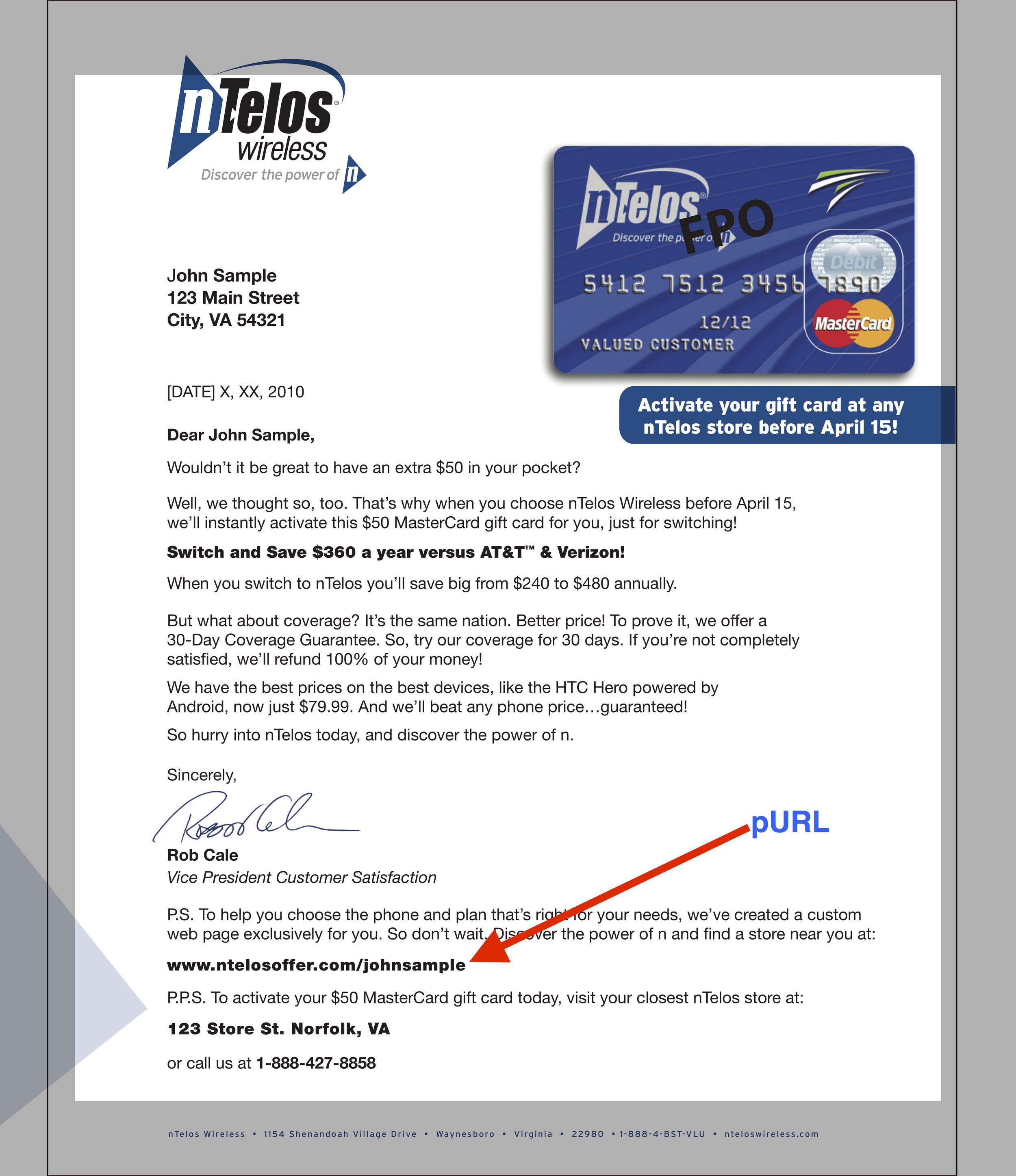
 Notice the personalized URL in this direct mail letter.
View fullsize

A pURL enabled mailer merges the domain name with the recipient's name. When typing or clicking the pURL, the displayed landing page contains the recipient's name. You can also insert other relevant information that is available in your database within any landing page.

Here's an example of a pURL landing page.

View fullsize

According to a Boingnet study (a company that provides advanced pURL support and reporting), pURLs can increase response by 3x for B2B campaigns. This higher response assumes you follow up each pURL with a phone call, email. and other appropriate channels. pURLs that are not supported with detailed reporting and response follow-up do not work as well. Here's an instance where automation makes a significant difference.

The following flow chart shows how to set up an effective pURL system that will increase response rates and reduce your Cost per Sale.

View fullsize

With proper support, adding pURLS to your direct mail program does not have to keep you up at nights. Please contact me if you want to test such a campaign for your company. My email is tedgrigg@dmcgresults.com.

Ted Grigg

Ted Grigg is a direct response strategist who helps growth-focused companies reduce risk by identifying weak assumptions before they become costly mistakes.

Over the course of his career, Ted has evaluated several hundred million dollars in direct response testing across direct mail, digital, print, television, telephone, and other channels. His work combines direct response strategy, acquisition economics, customer analysis, creative evaluation, offer development, and disciplined testing.

Ted has worked on both the client and agency sides of the business. That experience gives him a practical understanding of the pressures facing executives, marketing teams, agencies, and service providers—and of the problems that arise when activity, media volume, or creative preference replaces a clear economic objective.

His consulting work helps organizations examine such questions as:

  • Are acquisition goals economically realistic?

  • Is the allowable Cost Per Sale supported by customer value?

  • Are targeting, offers, creative, media, and response paths working together?

  • Are tests structured to produce reliable business decisions?

  • Are unproven assumptions being treated as facts?

  • Is the organization measuring sales outcomes rather than convenient proxies?

Ted’s experience includes the development of direct mail and multichannel acquisition programs for insurance, healthcare, financial services, technology, nonprofit, manufacturing, retail, transportation, communications, government, and business-to-business organizations.

For a national direct-to-consumer insurance company, he developed a direct mail format that defeated established controls and helped expand the productive use of compiled prospect lists from less than 10 percent to more than 30 percent of total direct mail circulation within one year. He also planned Medicare lead-generation programs for more than 60 regional and national HMO and PPO organizations, with some programs exceeding sales projections by as much as 60 percent.

Ted founded Wyse Direct, a direct marketing division of Wyse Advertising in Cleveland, where he developed acquisition programs and helped launch a new technology product for Seiko Instruments by generating a predictable flow of qualified sales leads for its national sales organization. As vice president of new business development for the Grizzard Agency, he helped broaden the agency’s strategic capabilities and pursue new commercial and fundraising opportunities.

He is the author of The HMO/PPO Marketing Plan—A Step-by-Step Guide, published by Executive Enterprises, and has written numerous articles and conducted webinars on direct response strategy, testing, creative development, and marketing economics.

Ted earned a Bachelor of Arts degree from Abilene Christian University and completed two years of graduate study at Texas Tech University. He is the founder of DMCG, LLC.

http://www.dmcgresults.com
Previous
Previous

The 3 Most Successful Direct Mail Formats

Next
Next

The State of Advertising as Seen Through the Eyes of a Direct Marketer