
“Marketing is not only much broader than selling; it is not a specialized activity at all. It encompasses the entire business.”
— Peter F. Drucker, The Practice of Management, 1954
Peter Drucker understood something that many companies still struggle to put into practice. A business must be managed from the customer’s perspective, not simply through the separate functions of marketing, sales, finance, operations, and customer service.
Yet many companies continue to treat customer relationship management (CRM) primarily as a sales support system. It records leads, tracks opportunities, schedules follow-up activities, automates some portions of a campaign, and reports sales results. These functions are important, but they represent only a fraction of what a properly designed CRM infrastructure should contribute to the business.
The larger question is whether the company has developed an information system that can support management decisions about customers, products, distribution, operations, profitability, and resource allocation. A CRM may accurately report thousands of transactions while failing to answer some of management’s most important questions.
The problem may not be the software. Management may never have established what the system needed to know.
The problem may not be the software. Management may never have established what the system needed to know.
What many companies call CRM is actually department-central information. Sales configures the system around pipeline activity. Marketing emphasizes campaigns and lead sources. Customer service records complaints and resolutions. Finance concentrates on revenue, margin, and cost. Each need is legitimate, but the result may still fail to show the company’s complete relationship with a customer.
That strategy contains a serious flaw. Customers experience the company as a whole, and the economic consequences of their behavior cross every departmental boundary. To serve the enterprise, CRM must be customer-centered. Its purpose, definitions, information standards, priorities, and accountability should therefore be governed by top management representing every department—not controlled conceptually by any single function.
My perspective comes from direct response marketing, where customer behavior and acquisition economics determine how capital is invested. Direct response has long depended on customer-level information to understand who responds, who buys, what they buy, what it costs to acquire them, how often they purchase again, and how much economic value they generate over time.
The CRM discipline has applications far beyond direct response. Customer behavior influences product development, inventory, distribution, staffing, cash flow, service requirements, marketing investment, and future growth.
CRM should make that behavior visible wherever it can improve a management decision. It should not replace management judgment, and customer behavior should not independently determine capital allocation. It should give management evidence that aggregate financial reports often reveal too late.
Begin With the Decisions, Not the Software
Before selecting, replacing, or redesigning CRM software, management should answer a more fundamental question: What decisions must this information system help us make? The answers should come from the executives and department managers responsible for those decisions, because the value of the system depends on what the business must know—not on the number of features the software can demonstrate.
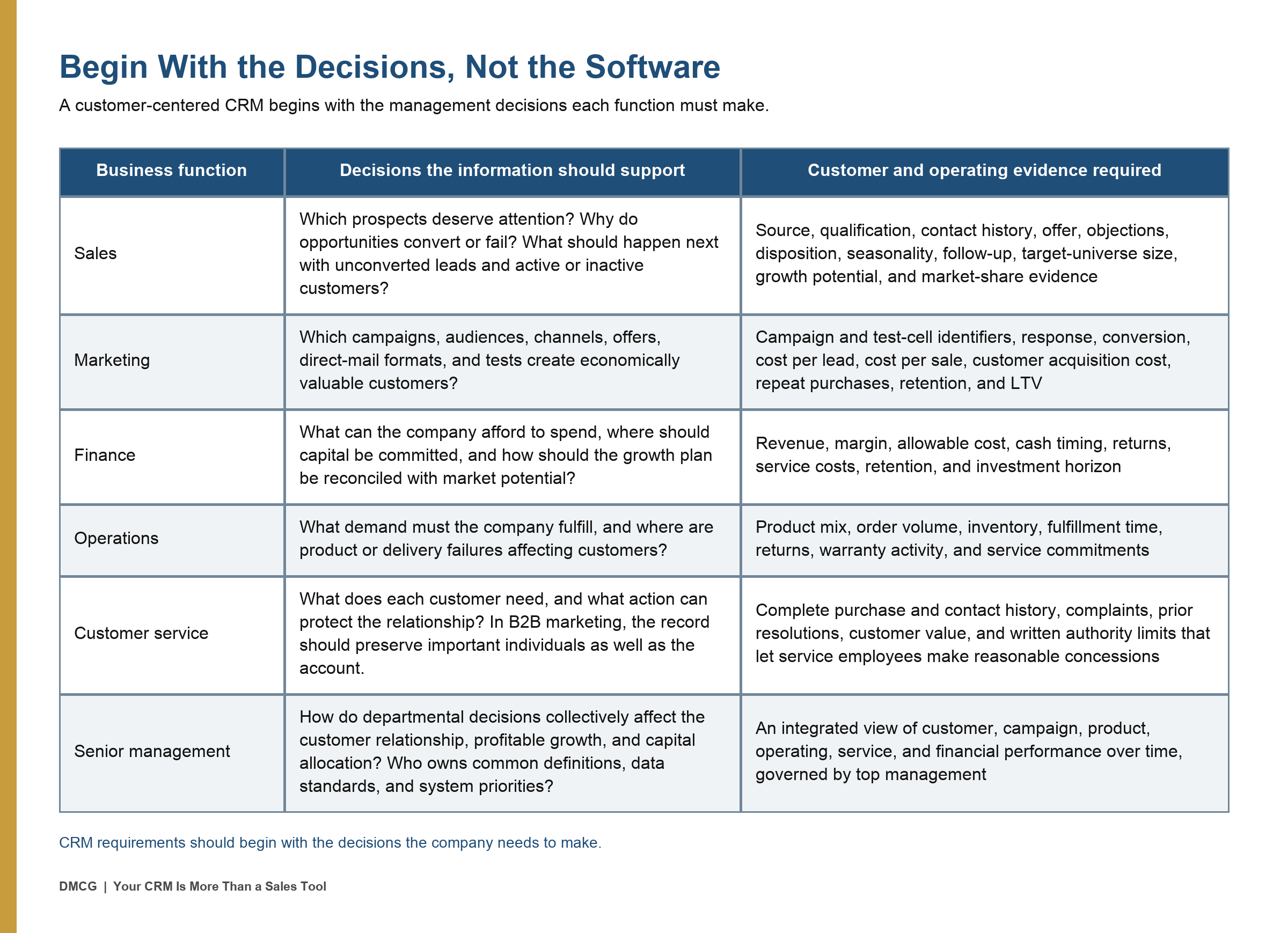
Table 1. CRM requirements should begin with the decisions the company needs to make.
The table illustrates why CRM cannot be designed as a departmental convenience. Most systems evolve around the needs of the department that first buys, configures, or uses them. That produces department-central information. A change in customer behavior, however, can affect marketing investment, sales forecasts, inventory, staffing, cash flow, service requirements, and product development. When each department sees only its own activity, people may make locally reasonable decisions that produce an undesirable result for the company.
This does not mean every function must operate in the same software. Accounting, inventory management, fulfillment, service, and marketing platforms may remain specialized. What matters is whether the company’s information architecture makes the necessary facts available, consistent, and useful across the enterprise.
The objective is not one enormous database. It is one dependable view of the customer relationship and its economic consequences.
The Customer Relationship Does Not End With the Sale
Consider what happens after a prospect responds to a campaign. The response becomes a lead—sales attempts to convert that lead into a customer. The customer buys a product, places another order, renews a subscription, asks for help, returns an item, complains, refers someone else, or stops purchasing. Each event adds information about the relationship.
Over time, that information should help the company understand more than what customers bought. It should reveal what influenced the initial response, what converted the sale, which products followed, how the customer experienced fulfillment and service, and what contributed to retention or cancellation. The CRM should preserve a coherent history of each customer’s experience with the company. That history helps marketing identify appropriate opportunities for additional sales and retention, while allowing management to connect an acquisition decision with its later financial consequences.
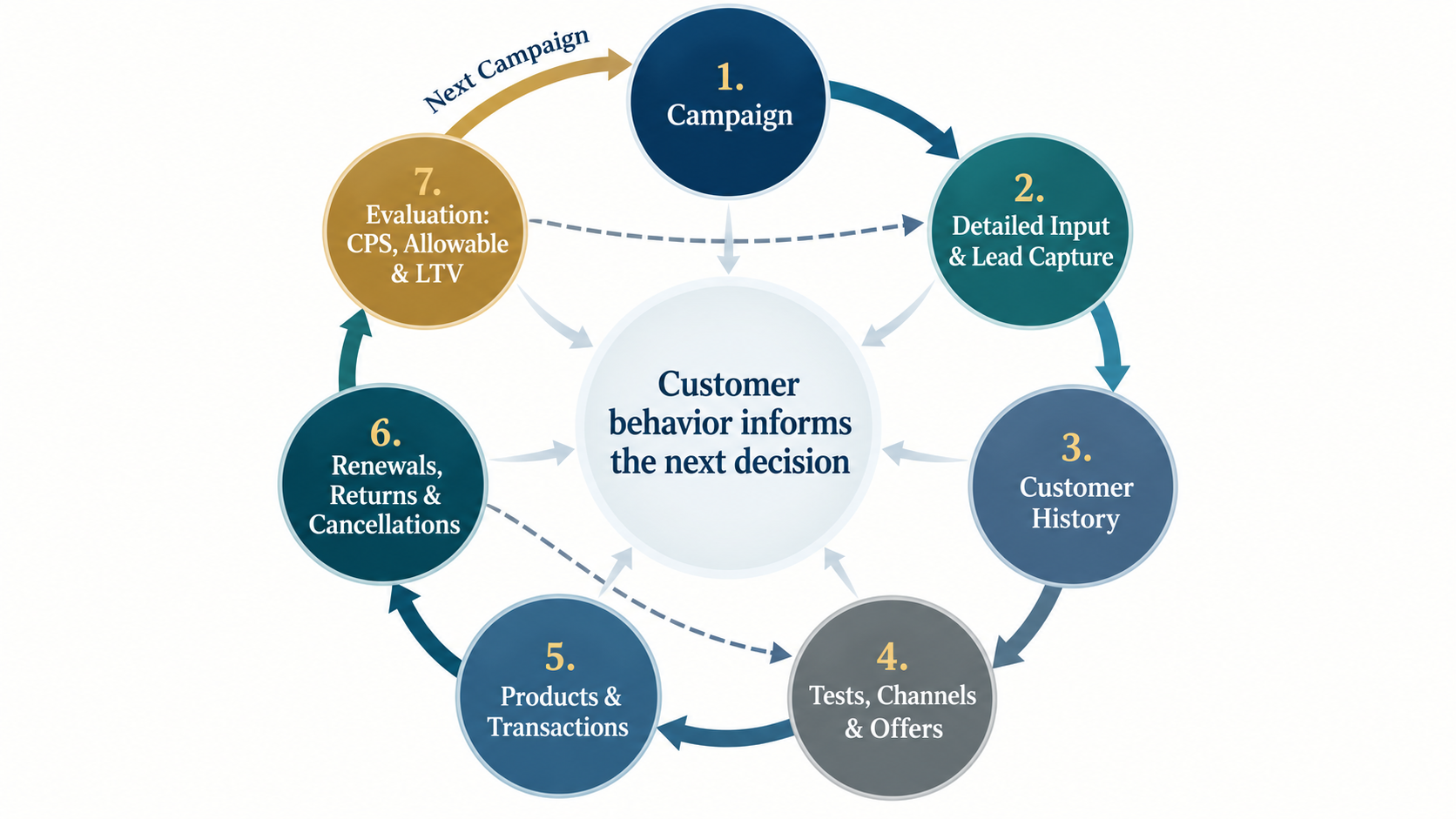
Figure 1. The CRM management lifecycle turns customer activity into evidence for the next campaign and the next management decision.
The outer circle shows why CRM should be managed as a learning system, not a transaction file. A campaign creates responses and leads. Detailed input preserves what was offered, to whom, through which channel, and under which test conditions. As prospects become customers, their histories accumulate across products, purchases, renewals, returns, service incidents, and cancellations. Management can then evaluate cost per sale, performance against the allowable, and lifetime value before committing money to the next campaign.
The feedback loops are equally important. A cancellation pattern may require a new offer, a different audience, a product correction, or a service change. An economic evaluation may show that management failed to capture information needed to explain performance. The company should then improve the next test and the next round of data collection. CRM creates value when the information changes a decision; merely storing the history does not.
This broader view can reverse conclusions based on the first sale alone. A customer acquired at an apparently acceptable cost may prove unprofitable because of returns, warranty expense, or weak retention. Another customer may begin with a modest purchase and become highly profitable through later transactions and renewals. A campaign that looks successful after 30 days may disappoint over the following year, while a campaign with a higher initial acquisition cost may produce customers whose long-term value justifies continued investment.
You can't fully evaluate customer acquisition without understanding what happens to customers after you acquire them. That is why CRM should preserve the relationship, not simply record separate transactions.
What Happens to the Leads That Do Not Convert?
Unconverted leads provide one of the clearest examples of inadequate CRM practice. Companies spend substantial sums identifying people interested enough to respond, yet some preserve little more than a name and the fact that no immediate sale occurred. Others keep the lead but fail to document the offer, qualification, contact attempts, objections, timing, or reason for the outcome.
Suppose a campaign generates 10,000 inquiries and 1,000 sales. Management receives a report showing a 10 percent conversion rate and the campaign’s cost per sale. That may be accurate, but it leaves the most important diagnostic question unanswered: What happened to the remaining 9,000 prospects?
Some may never have been qualified. Some may not have been contacted promptly. Others may have objected to the price, wanted a different product, encountered an ineffective salesperson, or been unable to purchase at that time. Without a complete disposition, management cannot distinguish weak lead quality from weak follow-up, an ineffective offer, poor timing, or an operating problem.
An arbitrary expiration date should not determine whether those leads retain value. If an older lead segment can still convert at an acceptable cost per sale—or performs better than prospects available through another investment—continued contact may be justified. If the economics do not work, management should stop. The evidence, not habit, should drive the decision.
Discarding a lead merely because the first sales effort failed wastes information the company already paid to acquire. It also hides what management needs to improve acquisition and conversion. Unsuccessful outcomes are not administrative debris. When captured properly, they become part of the company’s market intelligence.
Customer Experience Is Where Brand Promises Are Tested
Companies invest heavily in advertising and communications to establish favorable expectations. The customer’s experience determines whether those expectations are justified.
Imagine a customer who has held a company’s credit card for 50 years and calls about a billing problem. The representative knows little about the relationship. The customer is placed on hold, transferred between departments, and repeatedly asked to explain the same issue. The representative may recognize that the complaint is reasonable but lack the authority to resolve it. Eventually the customer asks the familiar question: “Can I speak with someone who can actually make a decision?”
The company may possess decades of purchasing, payment, and service history, yet the information has little value if it cannot be used when the customer needs help. This is not simply a service failure. It is a management failure to connect customer knowledge, accountability, operating policy, and decision-making authority.
A mature CRM infrastructure should help an authorized employee recognize the customer, understand the relevant history, identify unresolved issues, and select a reasonable response within established limits. It should also record the decision and its outcome. That allows management to learn whether similar complaints are increasing, whether repeated contacts signal a process failure, and whether particular remedies protect retention and customer value.
Not every customer demand should be granted, and value does not override fairness, policy, or legal obligations. But requiring management approval for every sensible accommodation is expensive and often destructive. Information without authority can be nearly as ineffective as authority without information.
This is where false economies become visible. A company may reduce service expense by shortening calls, limiting adjustments, or cutting staff while increasing unresolved complaints and losing customers. One departmental report improves while customer profitability deteriorates. Advertising may establish the brand promise; the company’s performance determines whether customers believe it.
A Customer Relationship Belongs to the Company
Departmental silos are often reinforced by how performance is measured. Marketing reports leads or response. Sales reports conversions. Operations reports unit costs. Customer service reports call volume and handling time. Finance reports expenses and margins. Each measure may be necessary, but none describes the complete customer relationship.
Consider a company that increases sales through an aggressive promotion. Marketing reports strong response, sales meets its revenue target, and operations fulfills the orders. Several months later, repeat purchases decline. Management assumes that customers were attracted only by the promotional price. But connected service and product data reveal an unusual level of complaints, warranty expense, and cancellations among customers acquired through the promotion.
The promotion may not be the underlying problem. The product, fulfillment, onboarding, or service experience may have damaged the value of customers the campaign successfully acquired. Without connected information, management could discontinue a productive marketing approach while leaving the actual cause untouched.
The same reasoning applies to employee accountability. Sales conversion should be considered with lead quality. Customer service productivity should be considered with resolution, repeat contacts, retention, and value. Fulfillment savings should be considered with delivery failures, returns, and future purchases. A department can have defined operating responsibility without being relieved of responsibility for the consequences its performance creates elsewhere.
A customer relationship belongs to the company, not to an individual department. Everyone who materially influences that relationship shares responsibility for its quality and economic consequences. CRM should make those consequences visible across departmental boundaries so management can correct the process rather than defend the silo.
Customer Information Belongs in Capital Allocation Decisions
Management continually decides where to commit limited resources. It must weigh product expansion, acquisition investment, retention, distribution, inventory, fulfillment capacity, staffing, and customer service. Aggregate revenue and expense reports describe what happened, but they may not explain which customers, products, channels, or experiences produced the result.
Direct response economics provide a practical framework. The allowable cost per sale establishes what a company can economically afford to spend to acquire a customer under defined assumptions about revenue, product cost, margin, subsequent purchasing, retention, servicing expense, and the investment horizon. The allowable is a financial control, not a number a campaign creates. Actual cost per sale shows how execution performed against that control.
If lifetime value improves because customers remain longer, buy additional products, or require less service, the financial model may support a higher allowable acquisition cost. If cancellations, returns, or service expenses rise, the economically supportable allowable may fall. That can reduce feasible acquisition volume and overall growth unless management corrects the underlying cause or improves execution. The change can alter which audiences, offers, channels, and campaigns remain economically viable. It can also reveal that the correct intervention lies outside marketing.
Customer behavior should not determine capital allocation on its own. Management must also consider capacity, liquidity, risk, competitive conditions, strategic objectives, and alternative uses of funds. But customer behavior provides evidence of actual demand and the economic value of satisfying it. It deserves a prominent place in the decision.
A company that can connect acquisition, transactions, retention, service costs, and lifetime value can recognize opportunities and problems earlier. One that cannot may keep investing based on averages or assumptions that no longer reflect its customers.
Information Quality Is a Management Responsibility
Sophisticated software cannot recover information that was never collected, and elegant reports cannot correct incomplete, inconsistent, late, or irrelevant data. Management must define what the company needs to know, who captures it, when it must be updated, how it will be verified, and who is authorized to act on it.
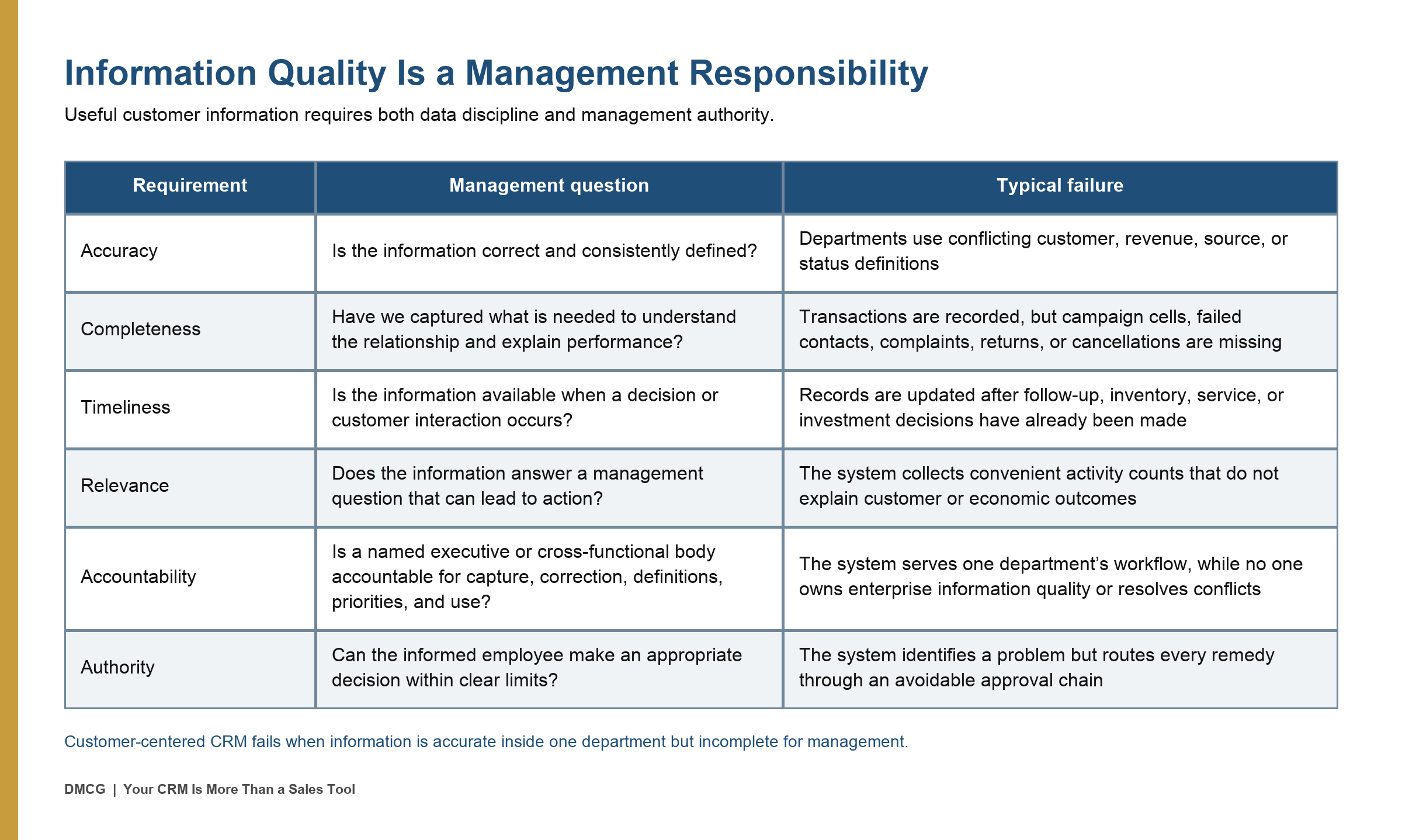
Table 2. Useful customer information requires both data discipline and management authority.
The distinctions in this table matter. Sales may record every completed transaction accurately while failing to document unsuccessful contacts by channel; the data are correct but incomplete for evaluating conversion. Marketing may identify an acquisition source while omitting the campaign or test cell; management knows where a customer originated but cannot explain which offer or treatment worked. Customer service may document complaints thoroughly without connecting them to later purchases or cancellations; the records are complete within the department but weak as management information.
Customer feedback from telephone calls and email is often lost because unstructured conversations are difficult to summarize consistently. Management needs a disciplined way to preserve recurring themes, concerns, and outcomes without forcing every interaction into an oversimplified checklist. AI-assisted summarization can help classify and condense this feedback, but common definitions, validation, and human review remain essential. Solving the problem gives sales and customer service a more useful customer history while helping management recognize patterns across many relationships.
The fix is to collect everything. Excess data creates cost, inconsistency, and distraction. The correction is to work backward from decisions, define the minimum dependable information required, and assign responsibility for it. Some facts should be captured automatically, some entered by employees closest to the event, and some derived through analysis. In every case, management must know how the information will be used and what action a finding can trigger.
Governance also requires common definitions. A lead, qualified prospect, customer, active customer, cancellation, renewal, sale, and allowable must mean the same thing wherever the company relies on them. Otherwise, departments can present internally correct reports that cannot be reconciled. The argument then shifts from what should be done to whose number is right.
CRM Is a Management Discipline Before It Becomes a Technology Project
CRM improvement is often framed as a software implementation: select a platform, migrate records, configure workflows, train users, and produce dashboards. Those steps may be necessary, but they do not define the system's purpose.
The work begins with management decisions and customer economics. Top management must define the relationships the company needs to understand, the questions it must answer, the measures that connect departmental activity with company performance, and the authority required to act on what the system reveals. Because every major department influences the relationship, CRM governance should be accountable to the leadership responsible for the enterprise as a whole. Only then can leaders judge technology requirements intelligently.
That sequence also prevents a common mistake: automating an inadequate process. If the company does not record why leads fail to convert, a faster CRM will preserve the omission more efficiently. If service employees lack authority, a complete customer history may only help them explain why they cannot solve the problem. If campaigns cannot be connected to later customer value, more dashboards will produce more activity reports without improving investment decisions.
The objective is not perfect information. Management will always make decisions with some uncertainty. The objective is enough reliable information to distinguish a plausible explanation from an unsupported assumption, recognize when departmental success is damaging the enterprise, and improve the next decision.
The Larger Management Opportunity
Companies already possess much of the raw material required to understand customer behavior. It exists in campaign files, sales records, transaction systems, service contacts, fulfillment data, returns, renewals, cancellations, and financial reports. The problem is often that the information was collected for separate purposes and never organized around the management questions that connect them.
A properly designed CRM infrastructure can help close that gap. It can replace department-centered information with a customer-centered view showing management how customers enter the business, what they experience, what they buy, what they cost to serve, how long they remain, and how their behavior changes the economics of future acquisition and investment. It can also reveal where the company lacks the information or authority required to protect the relationship.
That does not turn CRM into a substitute for leadership. It makes CRM a leadership instrument.
When the company treats customer information as a sales record, it sees contacts and transactions. When it is treated as management infrastructure, the company can see causes, consequences, and choices. That is the difference between knowing that performance changed and understanding what management should do next.
Your CRM is more than a sales tool when it replaces department-central information with customer-centered management information—and when top management is accountable for using that knowledge to make better decisions about customer relationships and profitable growth.