
Is Your Lead Program Broken Because of an Internal Sales-and-Marketing War?
Summary
A lead program fails when Marketing and Sales have not agreed on the customer journey. Marketing may be measuring response, while Sales is judging sales readiness. Both may be right from their own side of the table.
The real issue is whether the company has clearly defined each stage of the journey - from target buyer and decision group to problem recognition, response, qualification, handoff, sales pursuit, CRM disposition, sale, and customer value.
The company needs one journey, one handoff standard, one CRM evidence record, and one economic test. Without those four standards, Marketing can keep producing names, Sales can keep challenging the leads, and management still will not know where the journey is breaking.
Lead generation is supposed to create sales opportunities. Too often, it creates an internal fight.
Marketing points to the numbers and insists the program worked because it produced leads. Sales looks at the same names and insists the program failed because the leads were weak, premature, incomplete, or not worth the chase. Management listens to both sides and usually asks, "Who is right?"
That may be the wrong question.
In many companies, both Marketing and Sales are telling part of the truth. Marketing may have created response. Sales may have received names that were never ready to become real opportunities. The deeper problem is that the company has never clearly defined the customer journey that both departments are supposed to support.
A response is not automatically a lead. A lead is not automatically a qualified opportunity. A qualified opportunity is not automatically a sale. And a sale is not automatically a profitable customer. Each step has to be defined, measured, and owned.
When that does not happen, lead generation quietly turns into a transfer of blame. Marketing defends the campaign. Sales rejects the leads. CRM records are incomplete. Good prospects disappear into the cracks. The company keeps spending money without knowing whether the failure is targeting, message, offer, qualification, handoff, follow-up, sales support, or economics.
That is how a lead program becomes a name-generation mill. The company does not need more names. It needs a shared map for turning interest into profitable business.
The Target Buyer Comes First
The customer journey begins before the campaign. It begins with the target buyer: the person who can make or authorize the final buying decision. In a mid-market company, that may be the CEO, owner, division president, CFO, CMO, COO, VP of Sales, or another executive with budget authority and responsibility for the result.
That is very different from targeting anyone who might respond. Many lead programs are built around accessible responders rather than real buyers. The campaign reaches people who will download, click, attend, inquire, or ask for information. That can be useful, but only if the company understands what those responses actually mean.
A lead program is not successful because it creates motion. It is successful because it creates a path to someone with the authority, influence, need, and economic value to justify Sales attention. Marketing must define the target buyer before it builds the program. Sales must confirm whether the buyer is real in the selling process.
What qualifies as a lead is where the first disagreement often begins. Marketing may define the target by title, industry, company size, prior behavior, or apparent need. Sales may know from daily experience that the actual decision is made elsewhere, or that the listed decision-maker rarely acts without internal support. If Marketing ignores that knowledge, the program may produce a response but fail to create an opportunity. The lead problem often begins before the lead exists.
The Buyer Is Surrounded
In serious sales, the buyer is rarely alone. Around the target buyer is a decision group. This group may include the head of Marketing, the head of Sales, the CFO, a CRM manager, a technical reviewer, an operations person, a procurement gatekeeper, an outside agency, or a trusted senior employee whose opinion quietly carries more weight than the organization chart suggests.
Forrester's 2024 business buying research reinforces that point. It reported that the average B2B buying decision involves 13 people and that 89% of purchases involve two or more departments. It also reported that 86% of B2B purchases stall during the buying process. The practical conclusion is clear: companies are not selling only by title. They are trying to move a decision system. [1]
Consider a simple example. A CEO may have final authority to approve a lead-generation audit. But the head of Marketing may feel exposed by the audit. The head of Sales may care mainly about lead quality and follow-up burden. The CFO may focus on cost and payback. The CRM manager may know that the data is unreliable. An outside agency may fear that its work will be questioned. A senior salesperson may know which prospects actually convert, but may not want yet another reporting requirement.
The CEO can say yes, but that does not mean the rest of the decision system is neutral. That is why campaigns that target a title while ignoring the people around that title often generate interest without creating enough internal support for a sale. Marketing must understand this decision-making group before creating the campaign. Sales has to help identify who appears in the sales process, who blocks action, who strengthens the case, and which objections are likely to surface later.
The Message Must Create Recognition
A strong lead program does not simply announce a service or ask for a meeting. It names a problem the target market already feels but may not have fully put into words. That is a different job from promotion.
Promotion says, 'Here is what we sell.' Direct response says, 'Here is the problem you may already be facing. Here is why it is important. And here is a practical next step you can take.'
The problem this article names is direct: a lead program may be broken because Marketing and Sales are fighting over the wrong issue. Marketing thinks the problem is weak follow-up. Sales thinks the problem is weak leads. The deeper question is whether the company has truly defined how interest becomes a qualified opportunity and how that opportunity becomes profitable.
That kind of problem recognition can move a serious buyer. It does not flatter the organization. It confronts a hidden weakness the executive may already suspect and worry about. The message must also speak to the decision group: the CEO who cares about profitable growth, the Sales leader who cares about wasted selling time, the Marketing leader who needs revenue proof, the CFO who cares about acquisition cost and payback, and the CRM manager who knows whether the system can support the promise being made.
A Response Is Only the Beginning
A response means someone acted. That action may be a form submission, phone call, email reply, meeting request, webinar registration, article inquiry, direct mail response, referral, download, or request for more information. It has value because it shows interest. But interest has to be interpreted before it can be treated as a sales opportunity.
The responder may be the final buyer. Or the responder may be an influencer, researcher, staff member, vendor, competitor, gatekeeper, or someone with no authority at all. The response may reflect urgent need, mild curiosity, future planning, internal research, price shopping, or simple information gathering.
This is where Marketing can overclaim, and Sales can overreact. Marketing overclaims when it treats every response as a lead. Sales overreacts when it dismisses every non-ready response as worthless. Neither reaction helps the company. A response is evidence. It needs context.
That context begins with the response trigger. What message, offer, article, question, example, event, or contact caused the prospect to act? A prospect who responds to 'reduce cost per lead' may be thinking very differently from one who responds to 'fix the sales-and-marketing handoff' or 'find out why qualified leads are not closing.' Sales needs that information before the first follow-up.
Qualification Must Be Agreed Before the Argument Begins
A qualified lead is a response that meets an agreed standard for Sales attention. That sounds simple. It rarely is.
The standard should consider fit, role, need, authority, influence, timing, potential value, and the likely next step. In some businesses, a qualified influencer may be more valuable than an unprepared executive because the influencer can help build the internal case. In others, only a buyer with budget authority deserves immediate Sales contact. The standard will vary. The need for a standard does not.
If Marketing and Sales do not agree on qualification before the program begins, they will argue after the results arrive. Marketing will claim it generated leads in accordance with its campaign rules. Sales will judge those leads by its selling reality. Management will be dragged into a debate that should have been resolved before the first dollar was spent.
That standard should not be designed by Marketing alone. Sales knows which inquiries become real conversations, which roles matter, which titles mislead, which companies stall, which objections appear, and which early signals usually predict a waste of time. But Sales should not be allowed to define lead quality only as 'ready to buy now.' That turns lead generation into order taking and destroys the value of early demand creation. Qualification is a shared discipline. Marketing should lead the system. Sales must validate it.
The Handoff Is Where Blame Begins
The sales handoff is the point where many lead programs quietly break. Too often, the handoff is treated as a mechanical transfer. Marketing sends the name. Sales is expected to follow up. If revenue follows, the program gets credit. If revenue does not follow, the argument begins.
That is not a handoff. It is a blind pass.
A proper handoff gives Sales the prospect's role, company context, response source, message trigger, known problem, likely buying stage, prior engagement, decision-group clues, and a recommended next step. Sales should understand why the lead matters before making contact.
This is also where responsibility has to become clear. Marketing should not escape responsibility simply because a name has been transferred. Sales should not be expected to guarantee that every accepted lead becomes a sale. But once a lead meets the agreed standard, Sales should accept responsibility for timely pursuit, honest disposition, and useful feedback. The handoff is not the end of Marketing's job. It is the point at which responsibility is shared.
That distinction is essential. A qualified lead is not a guaranteed sale. It is a lead that deserves disciplined Sales attention because it meets the agreed standard for fit, role, need, authority or influence, timing, potential value, and likely next step. Some qualified leads will fail to convert because timing is early, the decision group is divided, budget is delayed, the buying role is weaker than expected, a competitor is already favored, or the prospect needs more proof before moving forward. That does not make the lead worthless. It makes accurate Sales disposition essential.
Follow-up timing also matters. The Harvard Business Review article "The Short Life of Online Sales Leads" remains useful because it showed how quickly online lead value can decay when companies respond slowly or inconsistently. [3]
Sales Sees What Marketing Cannot See
Sales pursuit moves the journey from theory to reality. The salesperson discovers whether the problem is real, whether the prospect has authority or influence, who else is involved, what objections are active, whether timing is immediate or future, whether budget exists, whether a competitor is already favored, and whether the lead should advance, return to nurture, or be disqualified.
Marketing cannot fully know this from campaign data. A form field does not reveal hesitation. A download does not show internal politics. A webinar record does not show whether the prospect has authority. A click does not prove that the company can buy.
Sales hears the tone and the resistance. Sales sees whether the prospect is serious, confused, defensive, interested, cautious, or merely curious. That is Sales' unique contribution to the journey. But the intelligence from that relationship cannot remain private. If it stays in the salesperson's head, notebook, inbox, or memory, the company cannot learn from it. Marketing cannot improve targeting. Sales management cannot coach accurately. Finance cannot trust the economics. Management cannot diagnose the system.
This is where CRM discipline goes beyond paperwork.
The Shared Responsibility Behind Convertible Leads
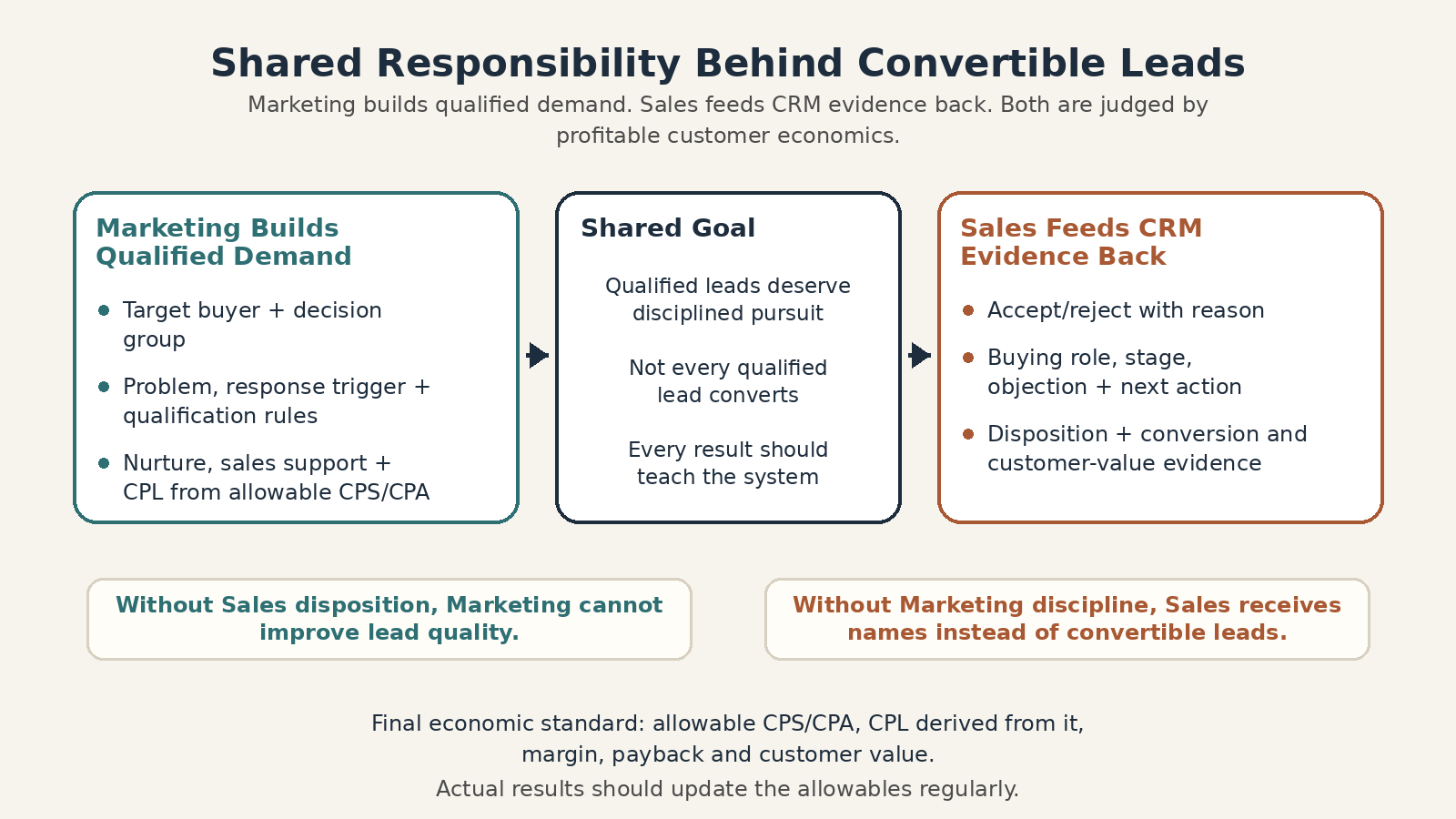
The shared responsibilities behind convertible leads: Marketing builds qualified demand, Sales feeds CRM evidence back, and both are judged by profitable customer economics.
Sales Must Save the Few Facts That Improve Lead Quality
Salespeople should not be buried in clerical work. Excessive CRM requirements create bad data,
resentment, and checkbox compliance. The goal is not to turn Sales into a reporting department. The goal is to capture the facts only Sales can know.
The CRM should show whether the lead was accepted or rejected, why it was rejected, if it was rejected, when the first follow-up occurred, what happened, what role the responder played in the decision group, what buying stage appeared likely, what objection mattered most, what next action was promised, whether an opportunity was created, whether the lead should return to nurture, and what final disposition occurred.
Those facts tell the company whether the journey is working or breaking. Without them, the lead program quickly becomes a name-generation mill. Marketing can keep buying or creating responses, but it cannot know whether the target was wrong, the message was weak, the responder lacked authority, the offer attracted curiosity instead of intent, the handoff was premature, Sales responded too slowly, or the prospect needed more nurturing.
Sales may be right that the leads are weak. But without documented evidence, that judgment remains private opinion. Marketing may be right that Sales failed to pursue good leads. But without a documented response and disposition, that claim also remains incomplete. The CRM should not exist only to inspect Sales. It should help the company build leads that Sales can convert.
The reason must be recorded because each non-conversion teaches something different. If the wrong person responded, Marketing may have a targeting or qualification problem. If the prospect needed more proof, Marketing may have a sales-support problem. If Sales responded too slowly, the company has a follow-up discipline problem. Some leads will also fall back in nurture, but without a clear reason, every failure gets thrown into the same vague complaint: bad leads.
CRM Data Makes Marketing More Accountable
The previous section explains what Sales must capture. This section explains why capturing it helps Sales. Good CRM data helps Sales by making Marketing more accountable. That may be the most underused argument for CRM compliance.
Salespeople often see CRM as a surveillance tool or an administrative burden. Used poorly, it can become exactly that. But used properly, CRM data protects Sales from vague debates over lead quality and forces Marketing to confront the economic quality of what it produces.
When Sales records what happened with discipline, Marketing can no longer hide behind lead volume, response rate, or cost per lead. Marketing must face whether its targeting, offers, messages, qualification rules, nurture paths, and sales-support materials are producing leads that Sales can convert at an allowable cost per acquisition. The allowable cost per lead should be derived from the allowable cost per sale or cost per acquisition, not set in isolation.
Gartner's research on Marketing and Sales collaboration supports the point. Gartner reported that the two functions typically collaborate on only three of 15 commercial activities, that 90% of executives said functional priorities conflict, and that organizations with shared buyer-journey insights are 2.3 times more likely to see higher sales conversion rates. [2]
If the company knows which leads were accepted, which advanced, which stalled, which returned to nurture, which became sales, and which became profitable customers, it can finally judge whether the program is producing customers at a cost the business can afford. Marketing becomes accountable not just for generating response, but for improving the quality and economics of the journey. Sales becomes accountable not for closing every lead, but for working qualified leads honestly and preserving the intelligence needed to make the next campaign stronger.
Not Every Unclosed Lead Was a Bad Lead
Some leads are not bad. They are early.
A prospect may have the right problem, the right company profile, the right decision influence, and the right long-term value, but not be ready to buy on Sales' schedule. If Sales simply drops that lead, the company wastes the money it spent to create interest.
A better journey gives Sales a way to return the lead to nurture with a reason. The prospect may need a different proof point, a different timing window, a stronger internal sponsor, clearer economics, additional education, or repeated contact until the problem becomes urgent. That does not make the lead worthless. It means the journey is not finished.
Marketing should own the nurture path for valid leads that are not yet ready for Sales pursuit. Sales should identify why the lead is not ready. Together, they keep quality leads in the hopper rather than letting paid interest go to waste. This is how fewer leads can produce more sales.
The Journey Must End in Customer Value
A sale is not the end of the measurement process. It is the first hard proof that the lead system can produce an acceptable business result. The company still needs to know whether the cost per sale or cost per acquisition was allowable, whether the margin was acceptable, whether the payback was reasonable, and whether the customer has continuing value. Cost per lead is not ignored; it is adjusted from the allowable cost per sale or cost per acquisition. Actual results should drive those numbers, and the allowable should be reviewed and updated regularly as conversion rates, margins, payback, retention, and customer value become clearer.
The final economic score is a shared responsibility of Marketing and Sales. Marketing must generate qualified leads at a CPL that supports the allowable CPS or CPA. Sales must pursue those qualified leads with discipline, document what happened, and help the company understand which leads convert, which stall, which return to nurture, and which should be disqualified. In most organizations, the responsible executive - often the CMO, CRO, CEO, or another accountable growth leader - must set the standard, require cooperation, reward responsible performance, and deal directly with individuals who repeatedly undermine the system.
The more precise goal is not more lead activity. It is a lead system that produces profitable customers the company can afford to acquire and keep.
That is why Marketing and Sales need a single journey rather than competing scorecards. Marketing should not win by producing low-cost names that do not convert. Sales should not win by ignoring qualified leads that require disciplined development. Both departments should be judged by whether their journeys produce profitable customers.
This is not a call for identical compensation plans or artificial harmony. Sales and Marketing live with different skills, pressures, incentives, and responsibilities. Those differences are not the problem. The problem is allowing those differences to create competing definitions of success. One journey. One handoff standard. One CRM evidence record. One economic test.
The Lead Problem May Not Be a Lead Problem
When a lead program fails, the visible complaint is usually simple: the leads are not good enough, or Sales is not following up well enough. Either may be true. But those complaints do not go far enough.
The company may have targeted the wrong buyer. It may have ignored the decision group. It may have created response without urgency. It may have treated curiosity as qualification. It may have handed off names without context. It may have allowed Sales to reject or neglect qualified leads without evidence. It may have lost early-stage prospects that should have stayed in nurture. It may have measured cost per lead while ignoring allowable cost per acquisition and customer value.
The internal war between Sales and Marketing is often a symptom of a journey no one has fully defined.
That is this first article's job in the series: to define the broken journey before moving into sales support, CRM intelligence, and cost-per-lead economics.
The company does not need more internal blame. It needs one shared map for turning interest into profitable business.
References
[1] Forrester. "Forrester: To Master B2B Buying Mayhem, Providers Must Prioritize Buyers' Needs." December 4, 2024. https://www.forrester.com/press-newsroom/forrester-the-state-of-business- buying-2024/
[2] Gartner. "Gartner Survey Reveals Marketing and Sales Functions Collaborate on Only Three Out of 15 Commercial Activities." June 3, 2024. https://www.gartner.com/en/newsroom/press-releases/2024-06-