
What a Direct Mail Creative Audit Should Actually Include Before Your Next Test
Article Summary: A direct mail creative audit should do more than judge copy, design, or brand appearance. Its real value is helping a company decide what to test next.
A serious audit should review the last 12–24 months of relevant acquisition, retention, and upsell activity, including current controls, past controls, losing test cells, A/B split tests, MVT structures, digital support media, landing pages, and available response data.
The objective is to identify what prior campaigns have already revealed, where creative or test structure may be weakening results, and which copy, visual, offer, format, response-path, or audience changes deserve priority in upcoming tests.
The best audit does not merely produce opinions. It turns prior creative, prior testing, and prior results into a sharper next-test agenda.
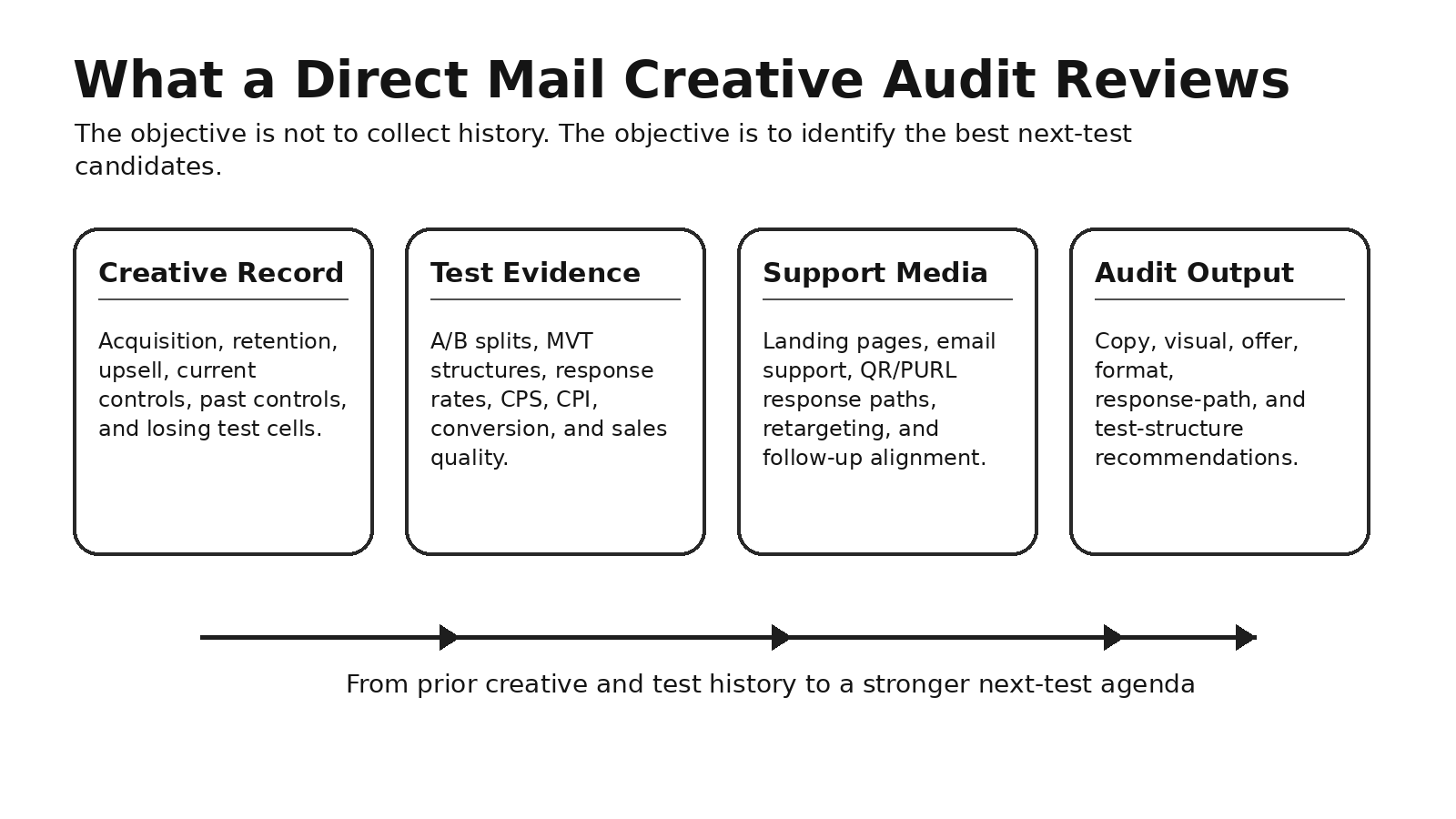
A direct mail creative audit converts creative history, test evidence, and support media into stronger next-test candidates.
A direct mail creative audit should not be an art review.
It should not be a search for prettier design, cleverer copy, or a more fashionable brand look. Those things may matter, but they are not the central issue.
The real purpose of a direct mail creative audit is to determine what your prior campaigns, controls, losers, test cells, offers, formats, response paths, and customer behavior suggest you should test next.
That is the part many companies miss.
They review the last campaign. They debate the copy. They argue about design. They look at response rates. Then they move quickly into the next campaign with only a partial understanding of what the prior work actually revealed.
A serious creative audit should do more than comment on what looks strong or weak. It should help answer a more valuable question:
What should we test next, and why?
That question matters because direct mail is too expensive to keep testing low-value changes while larger strategic weaknesses remain untouched. The issue is not whether the next test is “different.” The issue is whether it is different in a way that can improve response, reduce cost per lead, lower cost per sale, improve conversion quality, or identify a stronger rollout direction.
That requires more than creative opinion. It requires disciplined review.
One Campaign Sample Is Not Enough
When I audit direct mail creative, I prefer to see more than one mail piece.
One campaign may show what was mailed. It rarely shows the decision pattern behind the mail. It does not show whether the team has been testing meaningful differences or minor variations. It does not show whether the current control is still strong or simply unchallenged. It does not show whether losing tests were genuine failures or poorly structured tests. It does not show whether acquisition, retention, and upsell campaigns are being judged by the same economic discipline.
For most audits, I like to review the last 12–24 months of relevant activity. That usually includes acquisition campaigns, retention campaigns, upsell campaigns, current controls, past controls, losing test cells, A/B split tests, MVT structures where used, digital support media, landing pages, and available response data.
The objective is not to collect history for its own sake.
The objective is to see the pattern.
What has already been tested?
What won?
What lost?
What was repeated anyway?
What was never tested?
What did the team assume without proof
What changed the economics?
What merely changed the appearance?
Those are the questions that make an audit valuable.
Controls, Past Controls, and Losers All Matter
Many companies pay close attention to the current control. That makes sense. The control is the benchmark. It is the package, format, offer, message, audience approach, or response structure that the next challenger must beat.
But a creative audit should not stop with the current control.
Past controls matter because they show what once worked well enough to become the standard. They may reveal recurring principles: a stronger offer, a more direct headline, a more personal letter, a better response device, a clearer deadline, stronger proof, or a more useful format.
Losers matter too.
That surprises some people. Losing tests are often filed away as failures. But a losing test may still contain useful intelligence. It may show that the wrong offer was tested against the wrong audience. It may show that a strong idea was weakened by poor execution. It may show that a visual concept improved attention but failed to create response urgency. It may show that an offer lifted inquiries but hurt sales quality.
A losing test is not always a bad idea. Sometimes it is a good idea tested badly, measured incompletely, or buried inside a weak structure.
That is why the audit should examine controls, past controls, and losers together. The purpose is to identify the creative and strategic elements that deserve more confidence, less confidence, or a better test.
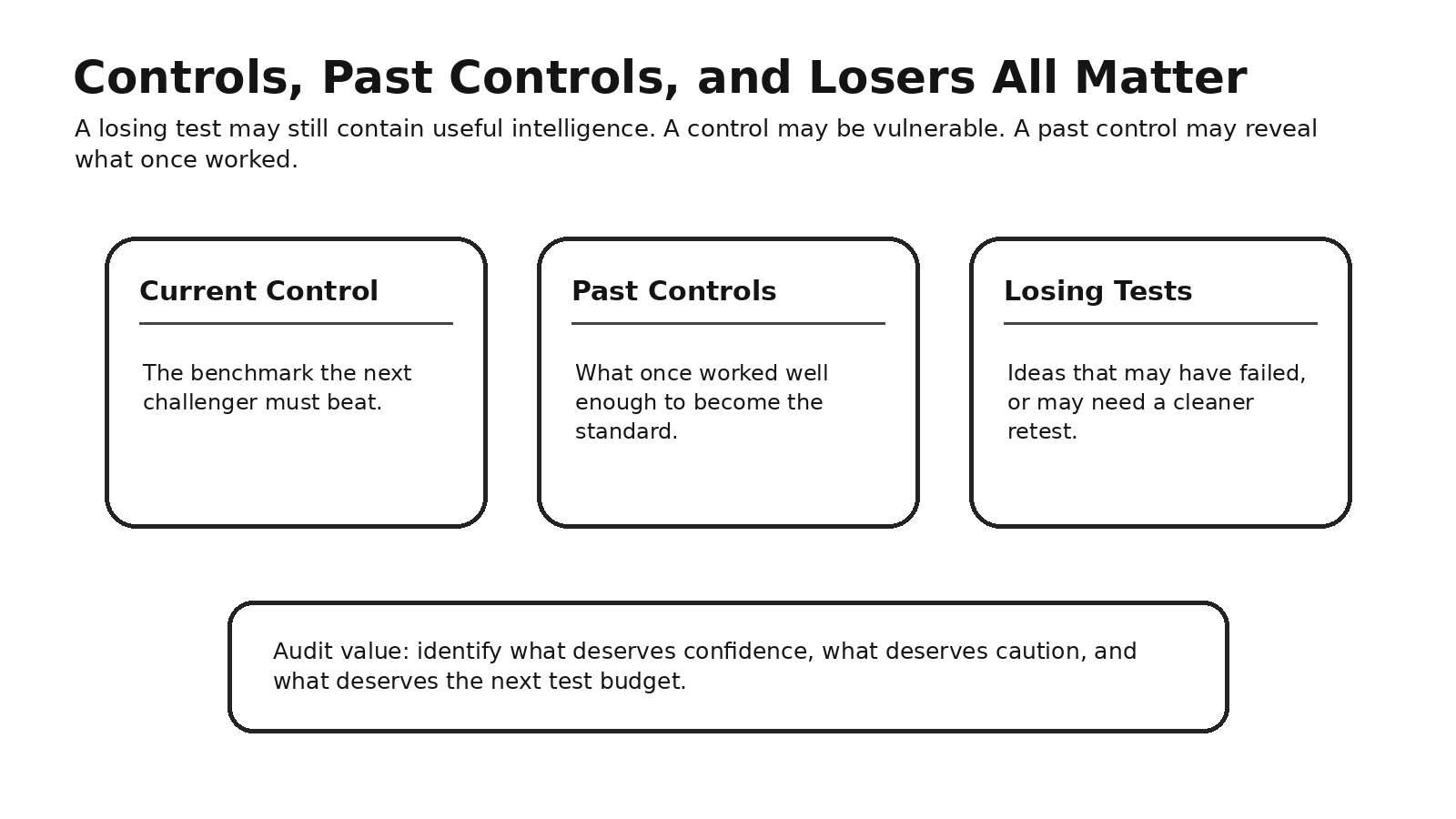
Current controls, past controls, and losing tests all contribute useful intelligence for the next-test agenda.
Response Rate Is Not Enough
Response rate is useful, but it can be misleading when used alone.
A campaign can produce more response and still produce poorer economics. A package can increase inquiries but lower conversion. An offer can generate activity but attract weaker prospects. A format can improve attention, but fail to move enough qualified buyers. A digital support sequence can produce more clicks without improving sales.
That is why the audit should review performance by test cell whenever the data is available.
At minimum, I want to understand response rates, cost per lead, cost per inquiry, cost per sale, conversion rates, and any available revenue or retention value. If cost per inquiry is the client’s working metric, that should be reviewed. If cost per sale is the controlling business metric, that must be part of the analysis.
The audit should ask whether the test produced better business results, not merely better campaign activity.
This is especially important when the company has multiple campaign objectives. Acquisition, retention, reactivation, upsell, and cross-sell campaigns may require different expectations. But they should still be judged by disciplined economics.
A retention package that lifts response but fails to increase profitable customer value may not be a true winner. An acquisition campaign that generates cheaper leads but weaker conversion to buyers may not be a true winner. A campaign that looks soft on response but produces better sales quality may deserve further testing.
For example, a lead generation campaign that offers a contest or drawing may generate many leads but produce very low conversion to sales. In that case, the campaign may appear productive on lead volume while still failing against the allowable cost per inquiry or cost per sale.
The numbers do not replace judgment. But without the numbers, judgment is working in the dark.
Creative Recommendations Still Matter
A direct mail creative audit is not only a data review.
The report should also make practical copy and visual recommendations to strengthen future testing. That may include changes to headlines, Johnson boxes, lead paragraphs, calls to action, testimonials, proof points, guarantees, deadlines, emotional sell-in, offers, photography, personalization, outer-envelope copy, response devices, landing-page alignment, or package format.
Sometimes the recommendation is to add something. Sometimes it is to remove something. Sometimes it is to revise, reposition, or isolate an element for a cleaner test.
A weak testimonial may need to be removed or replaced. A strong testimonial may need more prominence. A guarantee may reduce friction in one market and create compliance or credibility issues in another. A new photograph may strengthen relevance, or it may weaken the selling message by consuming space that could be better used for proof or response instructions.
There are no automatic answers. There are only testable recommendations supported by experience, prior results, and the specific selling problem the campaign must solve.
That is why the audit should not merely say, “This copy is weak,” or “This layout is cluttered.”
It should say what the weakness may be costing the campaign and what should be tested to correct it.
Layout Should Serve the Sale
In direct response, layout is not judged first by whether it could win a design award.
It is judged by whether it helps the reader understand, believe, and act.
Legibility matters. Scanning ease matters. Visual hierarchy matters. The offer must be easy to find. The call to action must be clear. Proof should not be buried. The response path should not require interpretation. The reader should not have to work too hard to understand why the message matters and what to do next.
This is where agencies and large clients sometimes get into trouble. They sacrifice sales performance for brand feel and look.
Brand standards matter. I am not arguing against brand discipline. But in direct response, brand expression has to support the sales argument. It should not weaken readability, soften urgency, hide the offer, reduce contrast, bury the phone number, make the response device harder to understand, or turn a selling communication into a brand mood piece.
The issue is not brand versus direct response.
The issue is whether the brand expression is disciplined enough to help sell.
A creative audit should examine whether the visual system helps the reader move through the selling sequence—or whether design and brand preferences interrupt sales momentum.
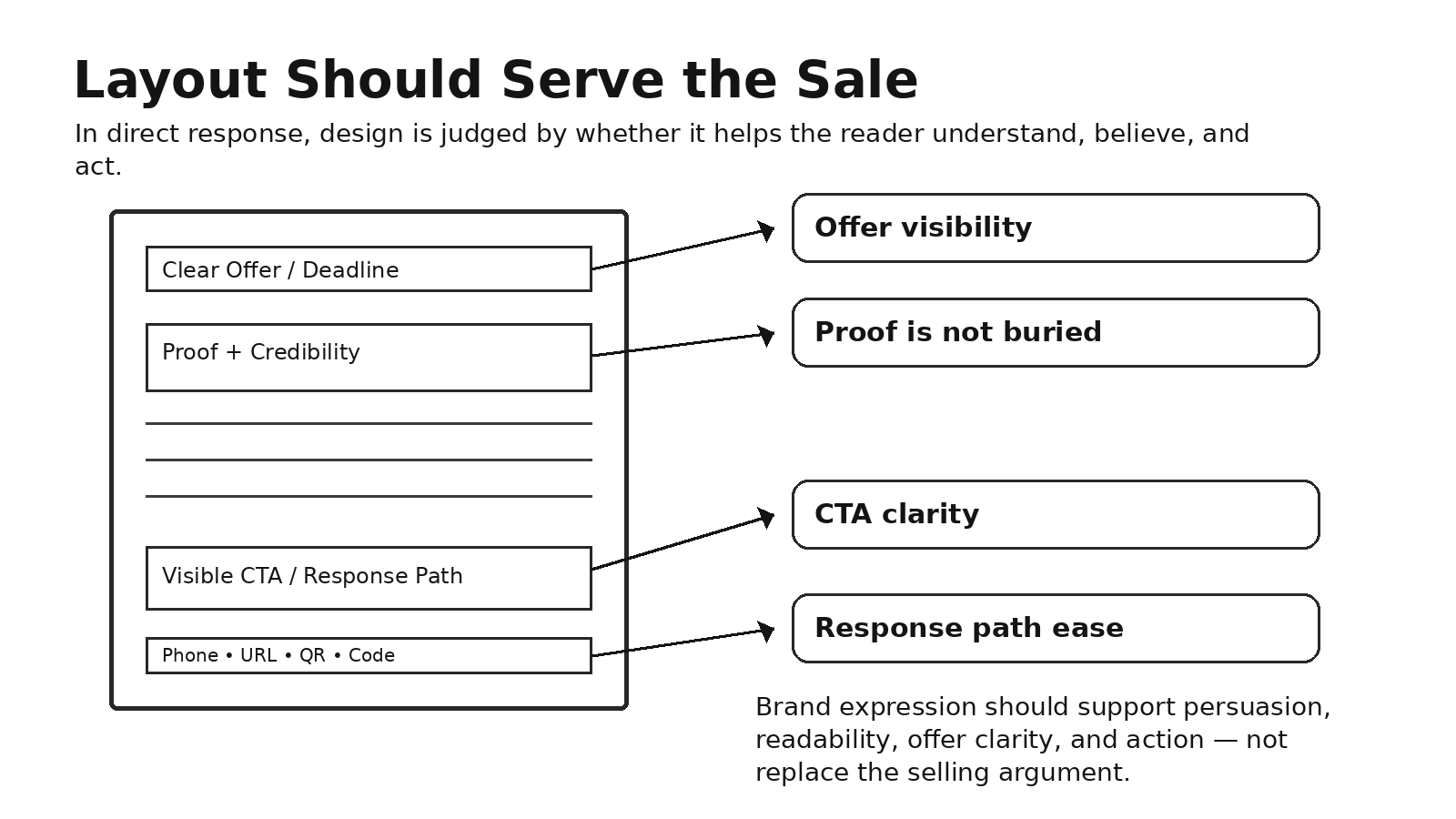
Direct response layout should make offer, proof, call to action, and response path easier to see and act on.
Direct Response Creative Must Build Sales Momentum
Creative brief discipline is often resisted.
Some creative people see it as excessive, unnecessary, or too high-brow. They want to get directly to the creative work. I understand that instinct. But in direct response, the brief is not paperwork. It is the discipline of forcing the team to examine the full selling opportunity before copy, layout, format, and offer decisions are made.
The team needs to understand the product benefits. It needs to understand the customer needs that those benefits fulfill. It needs to know the objections, motivations, proof points, reasons to respond now, response barriers, and the campaign’s economic goal.
Direct response creative has to do more than attract attention. It has to build sales momentum.
That means the copy and visual structure must move the reader from recognition, to relevance, to belief, to urgency, to action. A weak brief often leaves that sequence to chance.
A creative audit often reveals whether that discipline was present. If the mail piece has an attractive design but weak urgency, scattered benefits, unclear audience motivation, thin proof, passive response instructions, or a soft offer, the problem may not be execution alone. The problem may be that the selling strategy was never fully developed before the creative work began.
The audit should identify that.
Acquisition and Retention Should Not Be Treated the Same
Another reason to review 12–24 months of activity is that acquisition and retention campaigns often reveal different creative weaknesses.
Acquisition usually requires stronger credibility, clearer differentiation, sharper targeting, and more explanation. The prospect may not know the company, may not trust the claim, and may not yet believe the offer is relevant.
Retention and upsell campaigns have a different opportunity. The company already has a relationship. That relationship can allow for more personalization, greater recognition of past behavior, a more specific offer, a more direct appeal, or a more efficient sales argument.
But many companies fail to use that advantage.
They send existing customers copy that sounds like prospect copy. They ignore known purchase history. They underuse the customer relationship. They fail to acknowledge prior business. They miss opportunities to say, in effect, “Because we know who you are, this offer may be especially relevant to you.”
That does not mean customer data should be used carelessly. Regulations, privacy expectations, and brand judgment all matter. But when appropriate, retention and upsell creative should not sound as if the customer is a stranger.
A creative audit should examine whether acquisition, retention, and upsell executions are using the right selling logic for each audience.
The Response Path Deserves Its Own Review
A campaign can persuade the reader and still lose response because the response path is weak.
That is why the audit should review the mechanics of action.
· Is the phone number visible?
· Is the URL clear?
· Is the QR code useful or just decorative?
· Is the PURL explained?
· Is the response deadline prominent?
· Is the reply device easy to understand?
· Does the landing page continue the same message?
· Does digital support reinforce the mail piece or create a different argument?
· Does the call center script or sales follow-up match the promise in the package?
Response friction is often hiding in plain sight.
Sometimes the fix is simple: make the CTA more declarative, move the phone number, clarify the response code, add a PS, reposition the deadline, or give the reader a stronger reason to act now.
Sometimes the fix is structural: add a separate response device, change the package architecture, test outer-envelope teaser copy, split a combined letter/form into separate selling and response components, or align the mail piece with digital follow-up.
These are not minor production details. They can determine whether interest becomes action.
Digital Support Media Belongs in the Audit
Direct mail rarely operates alone anymore.
A prospect may receive the mail piece, visit a landing page, see a retargeting ad, receive an email, search the company, compare alternatives, and then respond through a different channel than the one emphasized in the package.
That means the audit should review the digital support surrounding the campaign whenever possible.
The issue is not whether every channel gets equal credit. The issue is whether the message is consistent, the offer is clear, the proof is reinforced, and the response path remains easy.
If the mail piece promises one thing and the landing page emphasizes another, response can weaken. If the mail piece creates urgency but the landing page feels generic, momentum can disappear. If the QR code leads to a page that does not continue the selling argument, the campaign has created a leak.
Digital support should not be treated as an afterthought. It is part of the selling environment.
Test Structure Must Be Reviewed Too
Even strong creative can be misread if the test structure is weak.
That is why the audit should review how tests were designed. A/B split tests and MVT structures can both be useful, but neither should be accepted without understanding what question the test was designed to answer.
Were the cells clean?
Was the sample large enough?
Were too many variables changed at once?
Was the timing fair?
Were source codes reliable?
Were audiences comparable?
Was seasonality considered?
Was the test judged by response only, or by CPS, CPI, conversion, and sales quality?
Did the test answer a business question that matters?
Testing is not valuable just because it is called testing.
The value depends on whether the test helps management make a better decision.
This is where many companies waste money. They test low-value variables because those variables are easy to change. They test small design differences while larger offer, audience, proof, format, or response-path issues remain untouched.
What to test is critical.
A creative audit should help determine whether the next test agenda focuses on the highest-value questions.
The Audit Should Produce Test Priorities
The final output of a creative audit should not be a long list of disconnected observations.
It should produce priorities.
Some recommendations may be easy production improvements. Some may be stronger copy or visual changes. Some may be offer tests. Some may be format tests. Some may require changes to response tracking, landing-page alignment, digital support, or sales follow-up. Some may require a cleaner A/B split test or a more disciplined MVT structure.
The audit should help distinguish between:
changes that can be made immediately,
elements that deserve testing,
ideas that require more information,
past tests that should not be repeated,
losers that may deserve a better retest,
controls that may be vulnerable,
and high-potential test candidates for upcoming campaigns.
A useful audit does not merely tell you what happened. It helps you decide what deserves the next test budget.
The Quality of the Audit Depends on the Quality of the Input
The complexity of the analysis depends on the reliability and detail of the information provided.
If the company can provide creative samples, test cells, response rates, cost per lead, cost per inquiry, cost per sale, conversion data, offer history, audience definitions, digital support, and sales follow-up information, the audit can go deeper.
If the information is incomplete, the audit can still provide value, but the conclusions must be more cautious. Missing data does not make the review useless. It simply changes the level of confidence behind each recommendation.
That is why I often develop follow-up questions after reviewing the initial input. Those questions help clarify or confirm what the creative record appears to show.
Sometimes the visible problem is a creative weakness. Sometimes it is a tracking weakness. Sometimes it is a sales-process issue. Sometimes it is a compliance restriction. Sometimes, an internal assumption shapes the work but does not appear in the campaign samples.
The questionnaire helps separate what can be concluded from what still needs confirmation.
The Point Is Better Testing
A direct mail creative audit should give you fresh, expert input before the next campaign is built.
It should identify what the last 12–24 months of activity suggest. It should evaluate current controls, past controls, losers, test structures, acquisition campaigns, retention campaigns, upsell campaigns, response paths, digital support, and campaign economics. It should make copy and visual recommendations where needed. It should call out weak selling structure, poor legibility, brand interference, unclear offers, missing proof, passive CTAs, and low-value testing habits.
But the most important output is sharper judgment about what to test next.
Direct mail testing is expensive. So is creative development. So is mailing another campaign that repeats weak assumptions.
A disciplined creative audit helps prevent that.
It turns prior creative, prior tests, and prior results into a more intelligent next-test agenda. It helps ensure the next campaign is not merely different, but better aimed at the selling problem that matters most.
That is what a direct mail creative audit should actually review before your next test.