
Article summary: Branding and direct response should not be treated as rival budget kingdoms. The better question is whether the total marketing investment produces management's economic goals. This does not require perfect channel attribution. It requires structured testing, response tracking, holdouts or comparisons where practical, and economic KPIs tied to leads, sales, conversion, retention, contribution, payback, and customer value. The hardest resistance is governance: brand advertising and PR lose protected status when their budgets are included in the same economic discipline as direct response. The second barrier is data: without a serious relational database, marketing opinion cannot become economic evidence. Proxies may guide the investigation. Economic results should govern the decision.
The Old Argument Is Too Small
People often argue about branding and direct response as if one approach must win and the other must lose.
That is the wrong fight.
Fans of branding often say direct response is too narrow, too focused on quick wins, and too tied to immediate results.
Direct response supporters sometimes say branding hides behind soft numbers like awareness, recall, preference, impressions, reach, frequency, and other indirect measures.
Both sides have a point.
But both arguments can miss the larger business issue.
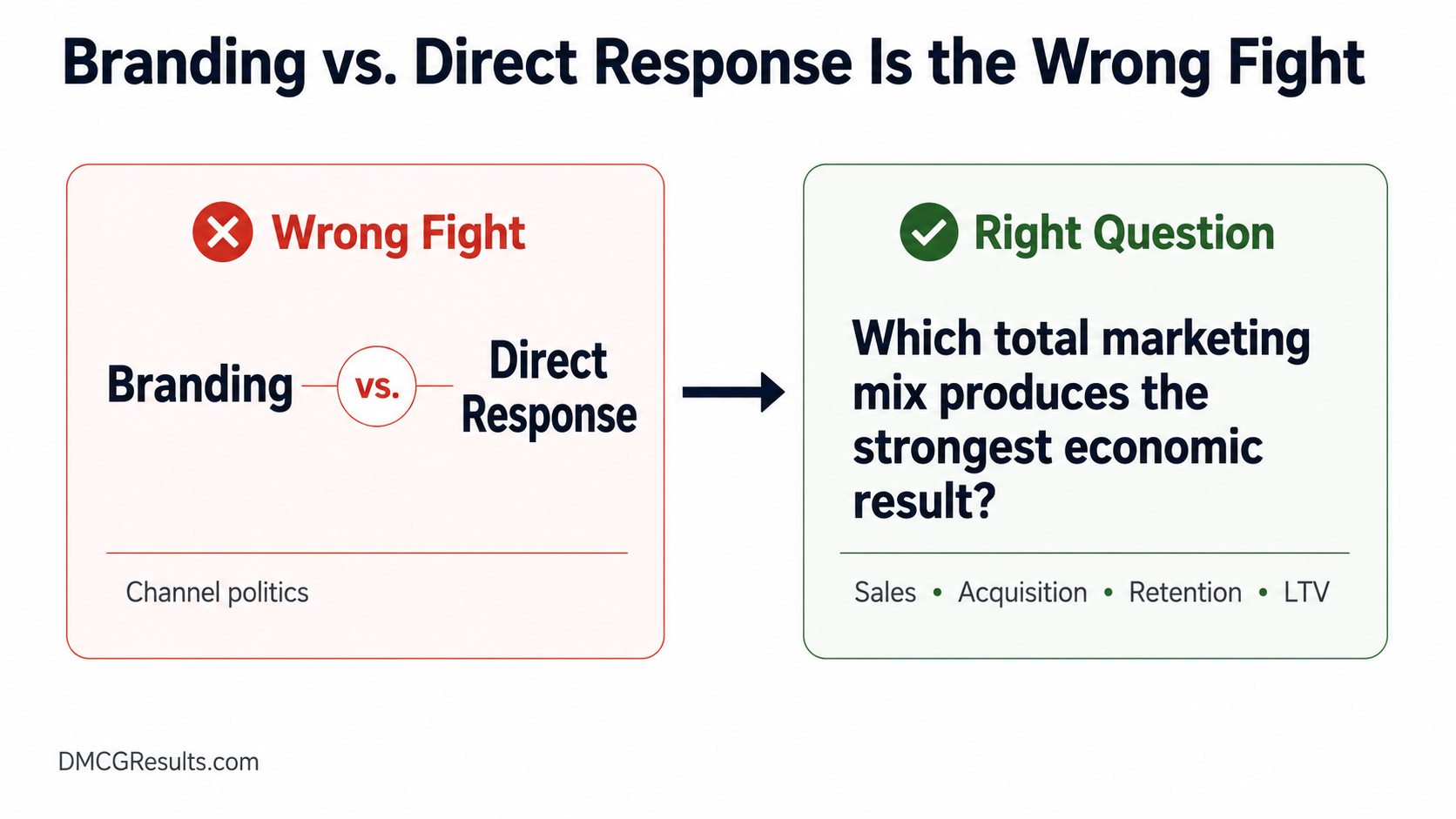
The real question is not which is better - branding or direct response. The real question is whether the total marketing spend is moving the business toward the economic goals management has set.
That is the issue management should care about.
The Starting Point: Proxies vs. Proof
The central distinction still matters.
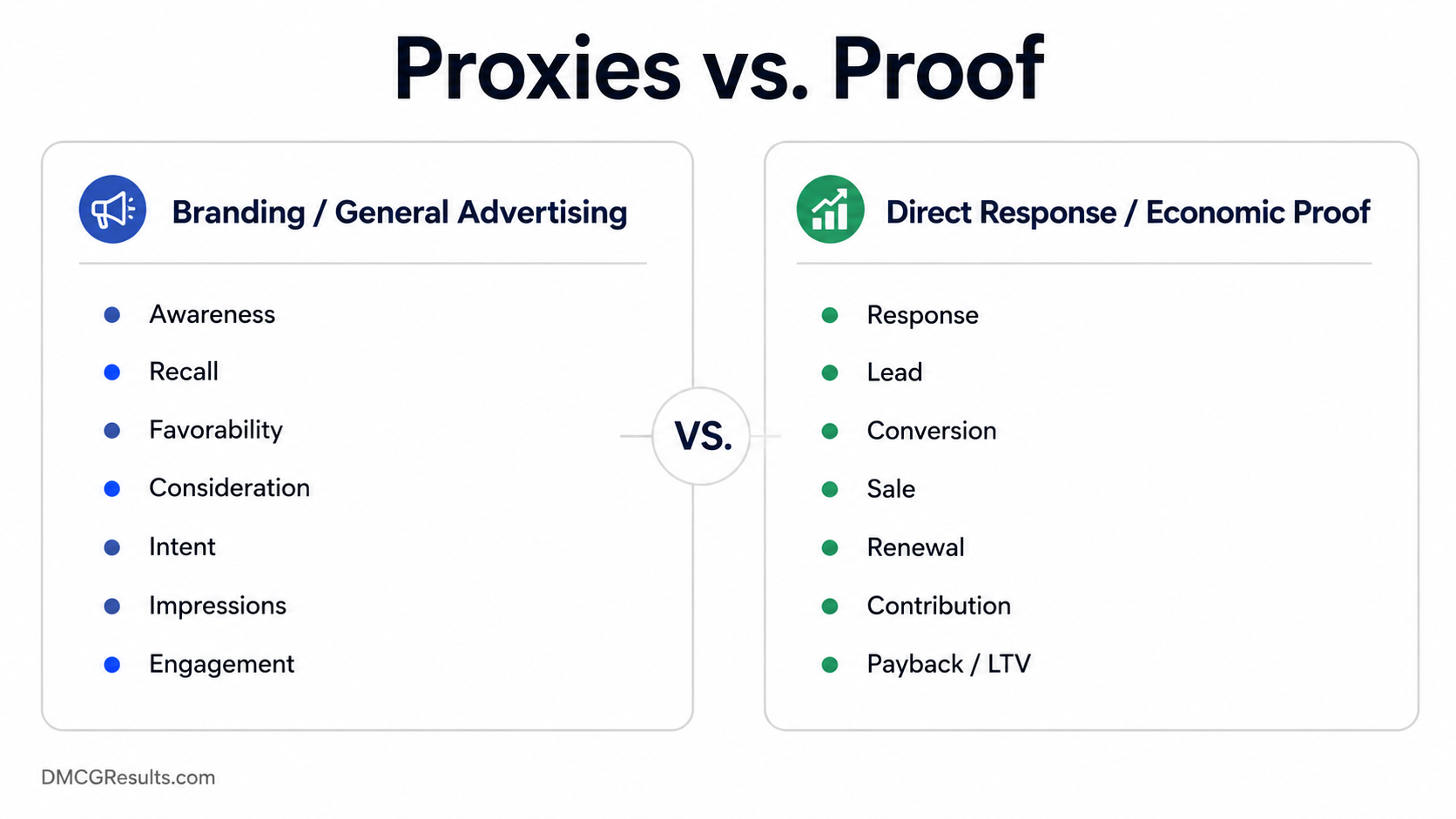
General advertising is often judged by proxies - indirect signs of impact. Direct response is judged by proof - real, trackable behavior.
Branding is usually measured through awareness, recall, recognition, favorability, consideration, intent, reach, impressions, frequency, engagement, and sometimes sentiment or share of voice.
Those measures are not worthless. They may show movement in the market. They may help a company see whether a message is being noticed, remembered, or associated with the right meaning.
But they are still proxies.
Direct response begins from a different discipline. It asks what people actually did.
Did they inquire? Did they call? Did they click? Did they apply? Did they request information? Did they buy? Did they renew? Did they convert?
Then it asks the tougher business question: did that response create customers, revenue, contribution, or long-term value at an acceptable cost?
That difference still matters today.
But that is the start of the conversation, not the end.
The harder question is this: what happens when branding and direct response both influence the same customer journey?
Branding Does Not Have to Lose This Argument
This is where many direct response arguments become too narrow.
Branding can matter.
Branding can create familiarity. It can reduce uncertainty. It can build trust. It can support preference. It can make a company feel safer, larger, more credible, more familiar, or more desirable.
That can help direct response rates.
A prospect who has heard of the company may be more likely to respond. A prospect who trusts the category may be more willing to inquire. A prospect who understands the promise may be less resistant to the offer. A prospect who feels less risk may be more willing to take the next step.
That means branding may deserve more budget, not less.
But the justification should not rest solely on proxy movement.
Branding deserves expansion when the combined evidence shows that it improves the economics of customer acquisition, conversion, retention, pricing power, repeat purchase, referral behavior, or lifetime value.
Direct response economics do not exist to kill branding.
Properly used, they can prove when branding deserves more money.
Advertising Leaders Saw Part of This Problem
This argument is not entirely new.
Some advertising and direct marketing leaders understood parts of this problem long before modern marketing technology made deeper tracking possible. Claude Hopkins argued for scientific advertising. David Ogilvy respected direct response because it forced advertising to be more factual, persuasive, and accountable. Rosser Reeves insisted on a clear selling proposition. John Caples belonged more directly to the direct response tradition, where testing and measured response were central. Lester Wunderman carried direct marketing into a broader business strategy.
They did not all make the same argument. Some were focused on copy. Some were focused on the selling proposition. Some were focused on testing. Some were focused on direct marketing as a business strategy.
But the common thread was important: advertising should not live only on taste, image, or creative preference. It should sell. It should persuade. It should be tested. It should be held accountable for what it accomplishes.
That tradition matters.
But it still does not go far enough.
The larger issue is not only whether direct response makes an advertisement stronger. The larger issue is whether direct response economics can help management govern the entire marketing budget.
That is the difference between using direct response as a creative discipline and using it as an economic discipline.
Marketing Spend Should Not Be Protected by Proxies
Proxies have value.
But they go only so far.
Awareness may rise. Recall may improve. Recognition may increase. Favorability may move. Engagement may look strong. Search activity may increase. Social discussion may grow.
Those signs may matter.
But they do not automatically prove that the spending deserves more money.
The business still has to ask the economic question.
Did the spending help produce sales? Did it improve lead quality? Did it increase conversion? Did it lower customer acquisition cost? Did it improve retention? Did it increase contribution? Did it improve payback? Did it increase customer lifetime value?
If the answer is yes, the spending may be justified by economic evidence.
If the answer is no, or if the company cannot tell, the proxy may be useful as a clue, but it is not proof.
Marketing should not be allowed to create its preferred argument for protecting or expanding budget. Management sets the economic goals. Marketing must show which mix of activities helps achieve them. It should also help management see whether overall spending should be increased, reduced, or shifted within the channel mix.
Some General Advertisers Do Track Sales Impact
This does not mean general advertising is always blind.
Some companies do track the sales impact of general advertising. Package goods companies may follow wholesale orders, distributor movement, retail sales, market share, promotional lift, geographic sales patterns, and other indicators tied to advertising spend.
Sophisticated companies can do this well.
Major package goods companies have used marketing-mix modeling, retail movement, sales lift, and market-share analysis when the economics were compelling enough and the measurement discipline existed.
But this is not as simple as it sounds.
Package goods companies often do not sell directly to the final customer. They may sell through wholesalers, distributors, retailers, or chains. The signal is more indirect. The buyer exposed to the advertising may not be the buyer recorded in the company's own transaction file.
That does not make the sales analysis useless. It makes it harder.
Sales Impact Takes Time to Stabilize
Sales can be influenced by many outside forces.
A competitor changes price. A retailer changes shelf position. A distributor pushes harder. A war changes the economy. COVID changes behavior. Inflation changes buying patterns. A product shortage shifts demand. A news event affects the category. A new competitor enters. A major retailer changes the rules.
These external events can create long tails in the data.
That means advertising impact may take time to stabilize. A short-term reading can be misleading. A lift may not be caused by the advertising. A weak result may not mean the advertising failed.
The company has to study change over time, compare patterns, and test where possible.
That is the missing element in many marketing arguments: change over time and testing.
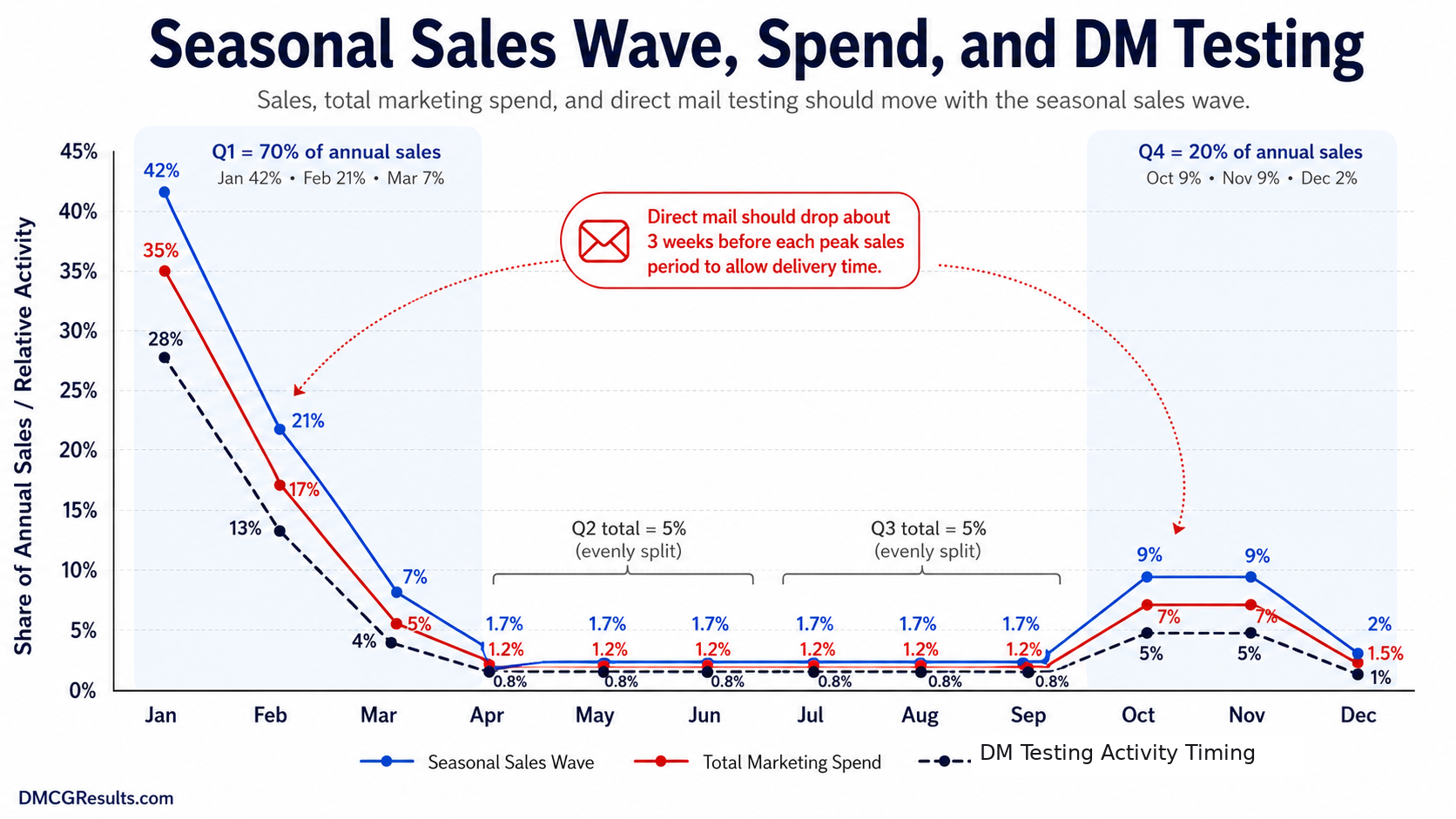
This visual shows how seasonality drives both marketing spend levels and DM testing activity timing. The sales wave determines when more budget should be committed and when direct mail testing should be concentrated.
Seasonality Can Make or Break the Test
Seasonality is not a side issue. In many direct response categories, it is part of the economics.
Veterans' life insurance companies historically spent a large share of their annual budget in the strongest response season. In some cases, 50 to 60 percent of the budget was concentrated from December through February across direct mail, DRTV, and print advertising.
They also performed most of their testing during the same season as their rollouts.
That matters.
A test conducted in the wrong season can mislead management. It may understate the strength of a package, overstate the weakness of an offer, or distort the allowable Cost Per Sale. A winter rollout should not be judged solely by a weak off-season test unless the company knows how that off-season result translates historically.
The larger principle is simple: test timing must match the decision timing.
If the rollout depends on seasonal response behavior, the test must account for that seasonality or be supported by reliable historical evidence.
When Branding and Direct Response Work Together, the Budget Still Has to Prove Itself
The real budget question is not whether branding works or whether direct response works.
The real question is whether the total marketing mix works.
Brand spending and direct response spending should be evaluated together when they influence the same customer acquisition and retention system.
Management should ask: What happens to leads, sales, revenue, conversion, retention, contribution, payback, and lifetime value when the total spend changes?
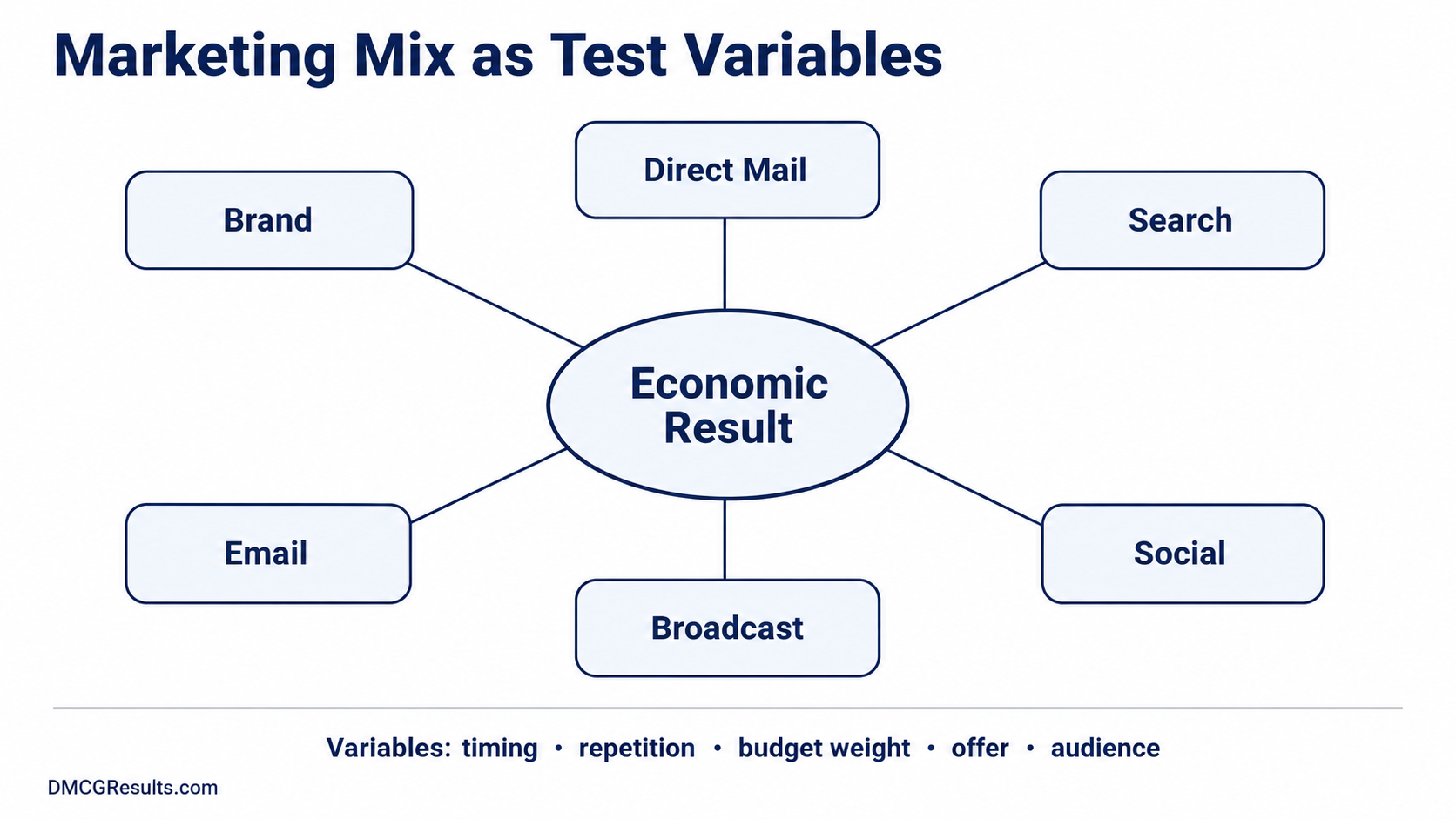
What happens when branding is added or increased? What happens when branding is reduced? What happens when direct response frequency changes? What happens when search, email, mail, broadcast, social, PR, sales support, or other channels are added, removed, increased, or reduced?
Channels are variables. Budget weights are variables. Timing is a variable. Repetition is a variable.
The real test is which mix delivers the strongest economic result.
That is a different question from, "Which channel gets credit?"
It is a better question.
Attribution Is Often the Wrong Battlefield
Many marketing arguments get trapped in attribution.
Who gets credit for the sale?
Was it branding? Direct mail? Search? Email? Retargeting? PR? Sales follow-up? A referral? Seasonality? A competitor's mistake? Market timing?
That argument can become endless.
Attribution has value. I am not arguing against it. Companies should track source, channel, offer, timing, response, conversion, and customer value as carefully as they can.
But attribution is not always the highest-level management question.
For management, the better question may be this: which combination of channels and budget weights produces the best trackable sales and customer-value outcomes?
The goal is not to crown one channel.
The goal is to determine the economically superior mix.
That is especially important in omnichannel marketing. The customer may receive mail or email, see digital ads, search for the company name, read reviews, encounter PR or reputation signals, visit a landing page, speak with a sales representative, and respond later through a different path.
Trying to give one channel all the credit may distort the decision.
The better question is whether the mix, as a system, produces profitable results.
The Attribution Belongs to the Total Marketing Investment
This is the point many channel arguments miss.
The attribution does not have to be assigned perfectly to each channel for the marketing investment to be governed economically. Management does not need every channel to win an internal credit contest. Management needs to know whether the combined spend improves the business result.
The attribution is to the total marketing investment.
That requires structured testing and tracking against actual response and actual business outcomes. If the total mix produces stronger leads, better conversion, higher retention, faster payback, higher contribution, or greater customer value, marketing has earned credit through quantified KPIs.
That is the proof management longs for.
The evidence may not be perfect. But it can be disciplined. And disciplined economic evidence is far better than allowing every marketing function to defend its budget with its own preferred story.
The Hardest Resistance Is Governance
The greatest resistance to this discipline may not be technical.
It may be political.
General awareness advertising has often been treated as sacrosanct. Brand advertising and PR are commonly defended through awareness, reputation, media exposure, message control, sentiment, share of voice, executive visibility, or market presence.
Those measures may matter.
But they should not become budget immunity.
This degree of accountability scares companies because it changes the internal rules. Once marketing spend is connected to response, conversion, retention, contribution, payback, and customer value, protected budgets can be challenged. Long-standing assumptions can be exposed. Agencies can lose authority. Internal teams can lose protected status.
That is why weak accountability often survives. It protects the story.
Branding was often sold on promises: we are building awareness, strengthening preference, increasing trust, creating demand, and improving reputation. Some of those promises may be true. But without disciplined economic evidence, they remain promises.
If brand advertising and PR are part of the same customer acquisition, retention, or revenue system, they should be evaluated as part of the total marketing investment. That does not mean every article, impression, mention, or exposure must be tied mechanically to a sale. It means the function must accept the same executive question every other marketing function should face:
Is this spending helping the business achieve its economic goals?
That is a governance change.
It may feel threatening because it moves brand advertising and PR from a largely narrative defense to a more disciplined economic conversation. But that is exactly the point. The goal is not to diminish brand or PR. The goal is to determine when they deserve more investment, less investment, different timing, different weight, or a different role in the marketing mix.
Brand and PR should not be protected from economic judgment.
They should be included in it.
The Objections Are Real
This sounds simple in principle.
It is not always simple in practice.
A company may not have clean data. It may not know which prospects were exposed to which messages. It may not connect response to conversion, conversion to retention, or retention to customer value. It may have reports, dashboards, and campaign summaries without a database strong enough to support economic judgment.
That does not disprove the discipline.
It exposes the first problem.
A company may also object that the sales effect is hard to isolate. That is true. Seasonality matters. Repetition matters. Competitive activity matters. External events matter. Media timing matters. Customer behavior changes. A short-term result may mislead management.
That does not mean the company should retreat to proxies.
It means the company has to test carefully, read results over time, use holdouts or matched comparisons where practical, and build enough history to understand the pattern.
Another objection is that channel attribution will never be perfect.
That is also true.
But this argument is not about giving perfect credit to every channel. It is about evaluating whether the total marketing investment produces measurable improvement in leads, sales, revenue, conversion, retention, contribution, payback, and customer lifetime value.
That standard is not easy.
But it is far more honest than proxy-only budget protection.
Holdouts and History Matter
Results do not stabilize instantly.
This affects both branding and direct response.
Repetition matters. Seasonality matters. External events matter. Competitive activity matters. Offer timing matters. Media costs shift. Customer behavior changes.
That is why holdouts matter.
That is why historical evidence matters.
That is why clean testing matters.
A company should test with and without selected channels where practical. It should test different channel weights. It should test timing. It should test repetition. It should test budget allocation.
Over time, a disciplined company should learn how different combinations of spending affect response, sales, retention, and customer value.
The stronger the history, the better the company can predict the economic impact of its marketing mix.
But that history only becomes useful if the company captures the right data.
The Relational Database Is Not a Technical Detail
This is where many companies fail.
They talk about marketing performance, but they do not maintain the database needed to understand it.
A company cannot enforce marketing economic discipline without serious data.
It needs to know who responded, when they responded, what they responded to, which offer was involved, which channel or channels touched the prospect, whether the person converted, what the person bought, whether the person renewed, how long the customer stayed, and what the customer was worth.
Without that, marketing arguments drift back to opinion.
The company may still have reports. It may still have dashboards. It may still have campaign metrics. It may still have agency presentations.
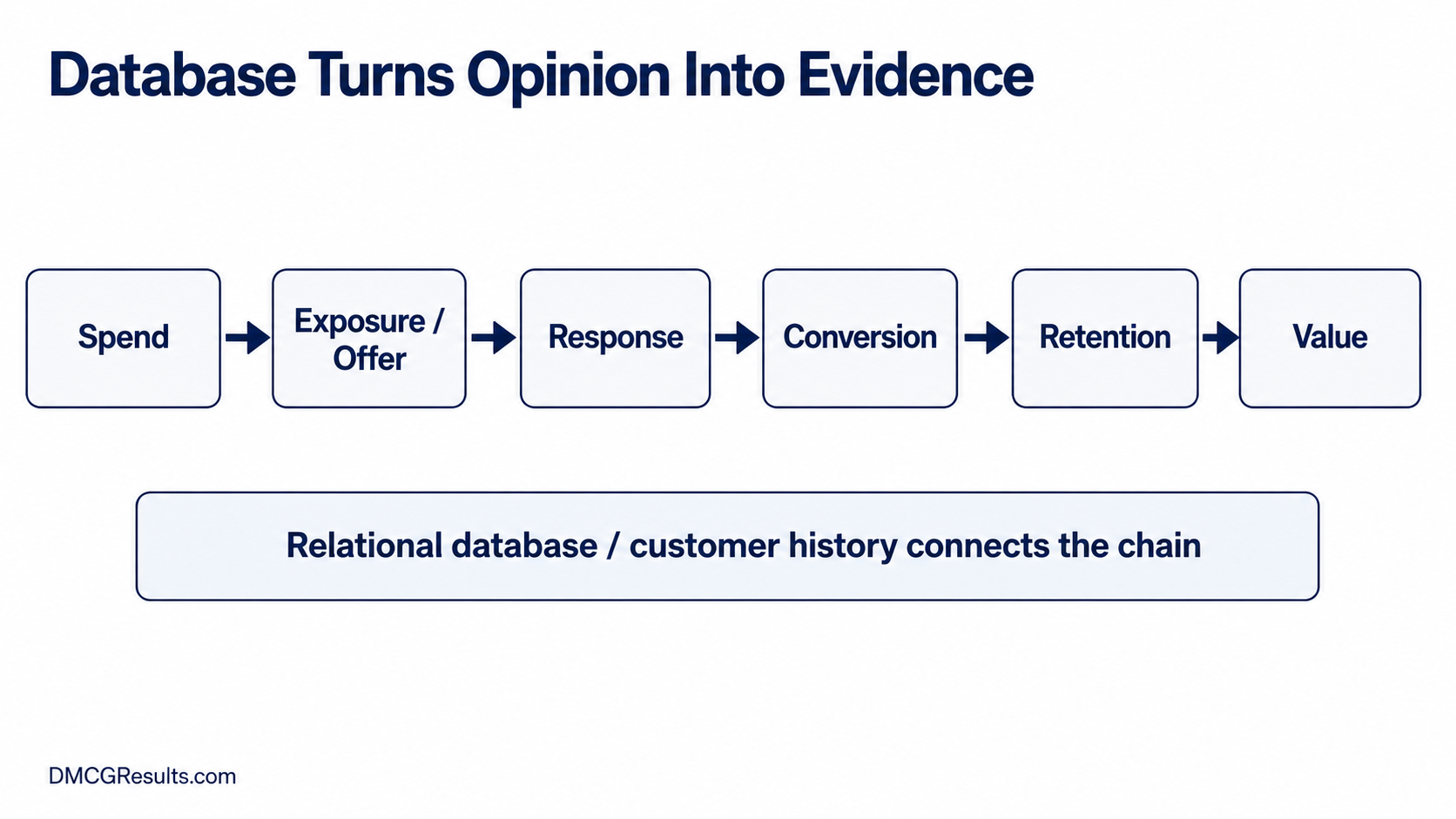
But if the underlying database cannot connect spend, response, conversion, retention, and value, the company cannot make disciplined capital-allocation decisions.
The database is where marketing opinion either becomes economic evidence or remains storytelling.
The Principle Applies Broadly, But Not Equally
The principle is this: marketing spend should be judged against economic results whenever the business can track those results with reasonable discipline.
That principle applies broadly, but not equally across every category.
Package goods companies may track wholesale orders, distributor movement, retail sales, market share, promotional lift, and other sales indicators. Some sophisticated companies do this well. Many do not.
But package goods are more complicated because the company often does not sell directly to the final customer. The signal is more indirect.
The discipline becomes more actionable in businesses that sell directly to consumers or depend on measurable lead generation.
That is where this argument has the most immediate force.
Where the Discipline Has the Most Force
Insurance. Medicare Advantage. Financial services. Subscription businesses. Fundraising. Home services. Franchise systems. B2B lead generation. B2C lead generation. Catalog and e-commerce. Continuity programs. Software companies. SaaS. Healthcare and service businesses with trackable responses. Any company with a prospect file, lead file, customer file, renewal file, or transaction history.
These businesses have fewer excuses.
If they can track response, conversion, retention, and customer value, they should not hide behind proxy-only budget arguments.
Direct Response Is Not the Ruler of Marketing
The argument is not that direct response rules all marketing.
That framing is too narrow.
It also invites resistance from people who hear "direct response" and think only of coupons, mail-order, late-night television, lead forms, or short-term selling.
The real point is broader.
All marketing spend should be judged against management's economic goals.
Direct response is one of the clearest disciplines for doing that because it begins with tracked behavior. But the principle is bigger than direct response.
Marketing exists to help the business produce economic results.
Some effects are immediate. Some are delayed. Some are direct. Some are indirect. Some can be measured cleanly. Some require longer observation, better testing, and more disciplined judgment.
But none of that removes the obligation to connect spend to business outcomes when the company can do so.
The Practical Decision Rule
Use brand spending where it can reasonably improve familiarity, trust, preference, response, conversion, retention, pricing power, or customer value.
Use direct response to ask for action, capture identity, track behavior, and evaluate economic results.
Use PR where it can support credibility, reputation, reassurance, authority, market presence, or risk reduction in ways that contribute to the same customer acquisition and retention system.
But do not evaluate any of them as isolated belief systems.
Evaluate the total mix against management's economic goals.
The question is not: do we believe in branding, PR, or direct response?
The better question is: which combination of spending produces the best measurable impact on sales, customer acquisition, retention, contribution, payback, and lifetime value?
That is the question that should govern the budget.
The Hard Truth
Branding may deserve more money. Direct response may deserve more money. PR may deserve more money. Search may deserve more money. Mail may deserve more money. Broadcast may deserve more money.
Some channels may deserve less.
Some may deserve none.
That decision should not be made based on internal preference, agency philosophy, vendor incentives, departmental protection, or channel politics.
It should be made by economic evidence.
Proxies may guide the investigation.
Economic results should govern the decision.
The real issue is not branding versus direct response. The real issue is whether marketing spend is aligned with the business's economic goals. Branding and PR may help create demand, credibility, trust, and market presence. Direct response may convert that demand into measurable leads, customers, sales, and retention. But the budget should be part of the mix that proves itself.