
Custom Fundraising Models and Rented Donor Audiences Require Different Controls
In one major annual fundraising campaign, donations fell significantly. The offer, creative, and timing had not changed enough to explain the decline. The campaign drew prospects from more than 75 rented donor and response files, many of which had performed predictably for years.
No one could identify the cause.
It took several weeks of analysis to discover that one important control list had changed the offer used to generate its names. The list owner had previously attracted people through an offer requiring a meaningful expression of interest. It replaced that offer with a contest.
The names were still classified as responders. But entering a contest required less interest and commitment than responding to the earlier offer. The label on the file had not changed. The behavior behind it had.
That one change weakened the annual campaign in two ways. The organization wasted acquisition dollars mailing a control list whose past performance could no longer be trusted. It also lost a major source of prospective donors from its available universe.
The lesson extends far beyond one list:
Past response is predictive only as long as the method that produced the names continues to generate consistent results.
Today, large fundraisers increasingly rely on propensity-modeled cooperative audiences and traditional rented donor files. That evolution has expanded the available universe, improved segmentation, and made multichannel targeting more practical. But it has not removed the risk revealed by this campaign. It has moved the risk deeper into the data and the model.
Management may now approve millions of acquisition contacts without knowing whose behavior created the prediction, what outcome the model was designed to estimate, or whether its inputs still represent the current fundraising environment.
Fundraising Acquisition Lists Have Changed
For decades, large direct-mail fundraising plans were built primarily from rented response files. These files contained people who had donated, purchased, subscribed, joined, inquired, or taken another measurable action.
That history mattered. Someone who had already responded to another organization's offer was generally more likely to respond again than someone selected solely on the basis of age, income, geography, or other demographic characteristics.
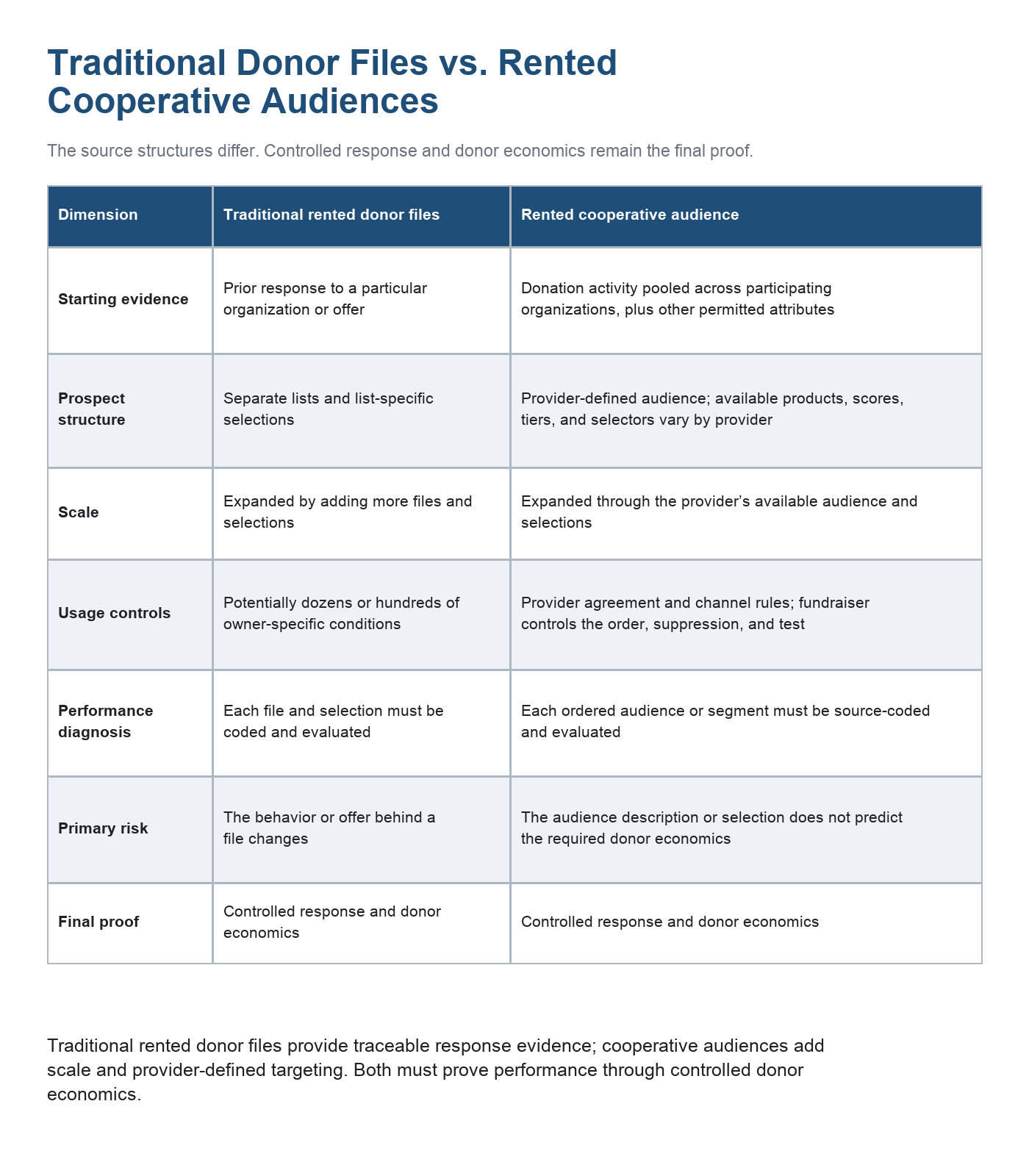
But traditional list plans were difficult to manage at scale. An annual program mailing millions of names might require dozens—or even hundreds—of separate files. Each could carry its own prices, selection charges, one-time-use terms, reuse rules, offer approvals, creative restrictions, drop-date requirements, and competitive exclusions.
Public list-rental pages still show this structure. The Upper Room Masterfile, for example, publishes a base price of $105 per thousand, with additional charges for recency, geography, and other selections. Reuse requires separate approval. The Direct Marketing Fundraisers Association also describes list rental as the one-time use of names and explains that list owners may restrict recent donors, competing organizations, sweepstakes offers, and other users. Published rates may differ from the negotiated prices paid by large mailers, but these public terms illustrate the cost and operational limits of building acquisition volume one rented file at a time.
Fundraising cooperatives changed that structure. Participating nonprofits contribute donor transactions and related promotional data to a much larger shared environment. Providers combine that history with other permitted information and use proprietary methods to identify prospective donors. The fundraiser then rents or licenses an audience, product, score, or available selection from the provider.
This is not simply a contest between “response data” and “compiled data.” Modern fundraising cooperatives are hybrids. Actual donation behavior may provide much of the foundation, while modeling, identity resolution, and additional attributes help determine which prospects appear most promising.
Data Axle reports that its DonorBase cooperative contains more than 83 million donors and 1.2 billion individual donations. Moore describes donor cooperatives as combining giving and promotional histories with added transactional, demographic, attitudinal, and behavioral data. These are provider descriptions, not independent performance guarantees. They do show how far fundraising acquisition has moved beyond the rental of individual donor lists.
A Custom Model Can Be Right About the Wrong Result
In this article, a custom propensity model means an acquisition model. The organization’s donor or campaign-response history defines the behavior the model is intended to find, and the model scores an outside compiled universe to identify new prospects. It does not refer merely to ranking donors already in the organization’s house file.
A custom propensity model is designed to estimate an outcome. That sounds obvious, but the word “propensity” is often treated as if it defines the outcome by itself.
Propensity to do what? To visit a page, make a first donation, give above a certain amount, renew, or become a profitable long-term donor? Those are not interchangeable results.
When an organization commissions a custom model, management should define the business result, understand the population and period used to build it, identify important exclusions and unusual conditions, and require validation against actual donor economics. A model can be statistically sound yet strategically wrong if it was directed toward the wrong people, outcome, or period.
The model does not correct a weak strategic definition. It executes it at scale.
A Rented Cooperative Audience Requires Different Questions
A cooperative provider controls its contributed data, proprietary methods, model architecture, and available products. The fundraiser generally cannot inspect every contributing source, choose every variable, define arbitrary new selectors, or require the provider to disclose its formula.
Management instead needs to know which audience, product, score, or available selection is being ordered; what donor characteristics or behaviors the provider says it represents; how closely that description matches the organization’s proven donors; what quantity will be tested; and whether each source or ordered segment can be evaluated separately.
Some providers may offer customized modeling engagements. When they do, the parties should identify what can actually be specified and validated. That possibility should not be treated as a universal feature of cooperative rentals.
The provider’s description helps management decide whether an audience deserves a test. It does not replace the test.
This Is a Targeting World, Not a Digital World
The growth of digital media did not make prospect data less important. It made dependable targeting more valuable.
A strong fundraising cooperative can create a ranked audience that supports direct mail, email, and digital activation. Data Axle, for example, says its cooperative audiences can be activated through mail and digital channels and that some email addresses are linked directly to donation history. That is different from purchasing a generic digital audience based only on platform behavior or broad inferred interests.
Digital platforms can find audiences without a donor file. But the platform generally controls identity matching, audience definitions, delivery, and reporting. A named or identity-resolved prospect universe provides the fundraiser with a more consistent starting point for deciding whom to reach and how to contact those prospects across channels.
This does not mean every channel can be used without restriction. Postal-list rights do not automatically provide permission for email, telephone, text, or platform matching. Each channel introduces its own licensing, privacy, consent, and suppression rules.
Mail and digital do not compete for the right to define the prospect. Better targeting increases the value of both.
The audience should come first. Channels should be assigned according to the evidence, economics, and rights available—not because the organization has declared itself “digital-first” or “mail-first.”
Testing Must Decide How Deeply to Roll Out
A rented cooperative audience should not be accepted or rejected solely on its description. It should be tested in the form in which it is actually available. Some providers offer products, scores, tiers, or selection options; others may provide a single audience meeting agreed criteria. Management should build its test around the choices the provider genuinely offers rather than assuming universal access to quintiles or deciles.
The stopping point should not be determined solely by response rate. Fundraising needs to track the progression from source to response, completed donation, average gift, net revenue, subsequent gifts, renewal, and long-term donor value. A high-response source may attract low-dollar donors who do not renew. Another may respond less often but produce greater revenue and stronger retention.
The practical governing measure is the allowable acquisition cost: the highest cost the organization can accept for the kind of donor it is acquiring, based on its financial objective and recovery period. Rollout should expand only as long as cumulative results remain within the allowable cost—unless leadership has deliberately approved a longer payback period or a different objective.
Traditional rented donor files can be tested against a cooperative audience—and often should be. Some may retain a strong cause affinity, gift pattern, or recent-response advantage that a broader product does not capture. They may also add valuable names outside the cooperative audience’s strongest selections.
The fair test must control the offer, creative, mailing window, geography, merge-purge treatment, suppression rules, source coding, and response period. Overlap must also be handled carefully. If the cooperative receives favorable merge priority, it may claim obvious responders that also appear on rented lists, making the comparison look stronger than it is.
The question is not whether cooperative audiences have made rented donor files obsolete. It is which source—or combination—produces the required donors within the allowable cost.
Management Must Control What It Can
Predictive modeling has made fundraising acquisition more scalable, more segmented, and more useful across channels. It has also made weak assumptions harder to see.
When commissioning a custom model, management should govern the prediction: the objective, population, exclusions, validation, and continuing relevance. When renting a cooperative audience, management should govern the test: the available selection, quantity, source identification, comparison, allowable cost, and rollout.
Management does not need every coefficient, variable weight, or proprietary formula used by a cooperative provider. It does need to understand what it is buying, which choices are available, how the audience will be tested, and what economic results will justify rollout.
In both cases, descriptions and statistical scores remain hypotheses until actual donors prove them.
For a custom model, can management explain what result it predicts and whose behavior it was trained on? For a rented cooperative audience, can management explain what was ordered, how it was tested, and whether the resulting donors justified the cost?
If the answer is no, the organization does not control its targeting strategy. It is financing an assumption it has not validated.
References
Data Axle Nonprofit: DonorBase — Provider description of a large fundraising cooperative built from donation activity and additional demographic, behavioral, and commercial data, with mail and digital activation.
Moore: What Is a Donor Co-op and Why Should You Use One? — A useful explanation of cooperative inputs, modeling, testing, data hygiene, frequent updates, and the importance of nonprofit-specific donor behavior. Performance statements are vendor claims.
Data Axle Nonprofit and TrueSense acquisition case study — A provider case study describing year-long, head-to-head testing of nonprofit cooperatives across 39 campaigns. It does not compare cooperatives directly with traditional rented donor files.
Statlistics: Upper Room Masterfile — Public response-file listing illustrating base pricing, selection charges, approval requirements, and separately approved reuse.
Direct Marketing Fundraisers Association: List Strategy for Acquisition — Industry presentation explaining one-time list rental, reuse, exchanges, donor-recency selections, list-owner restrictions, and acquisition planning.