
How direct response uses entry behavior, relationship history, and each next commitment to guide individual treatment from acquisition through lifetime value.
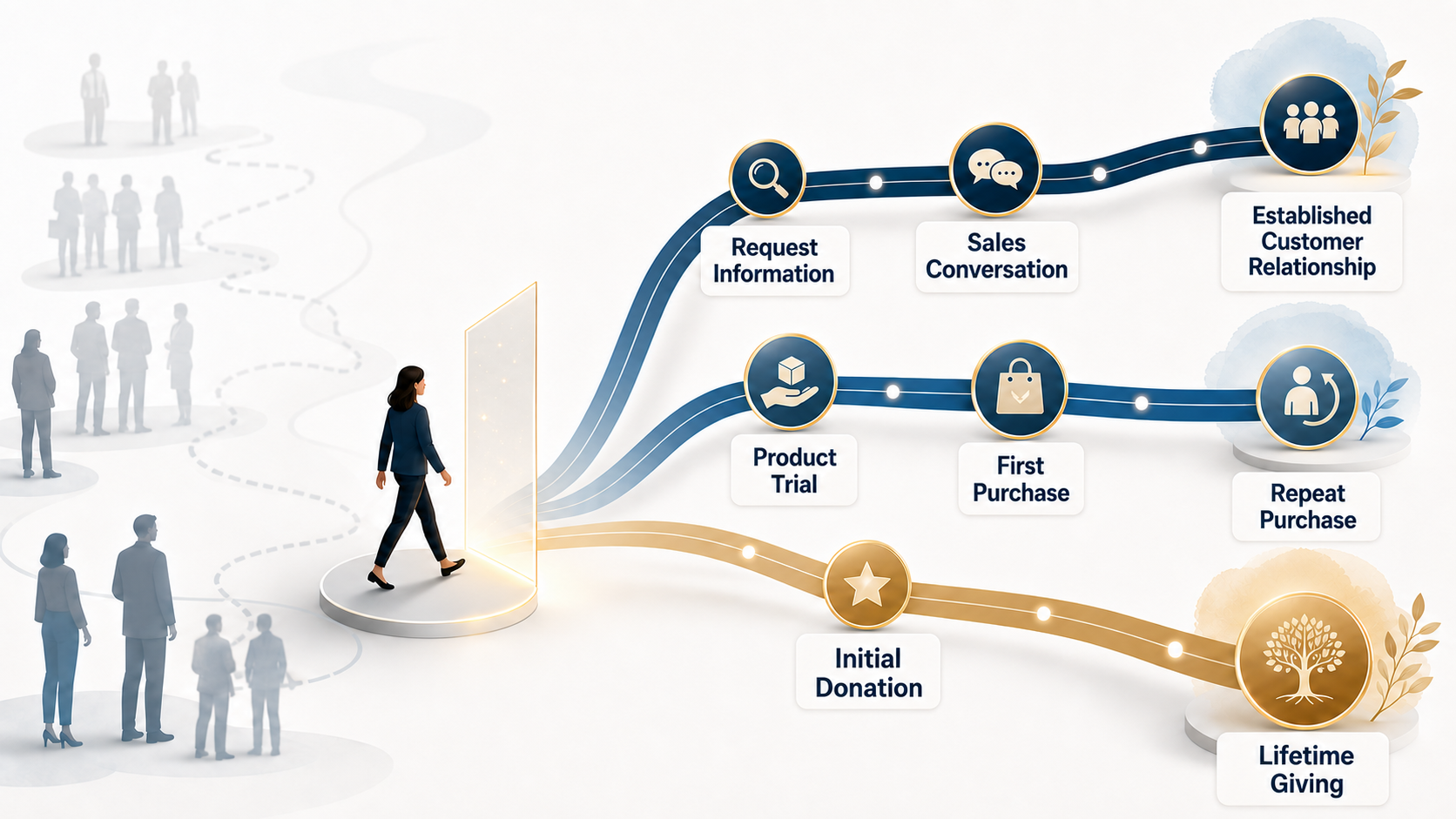
Each first commitment creates a different relationship history—and a different next treatment
The Journey Belongs to the Individual
Most customer-journey diagrams show groups moving through a common sequence: awareness, consideration, purchase, retention, and advocacy. The diagrams can help management see the broad process. But they can also hide the most important fact about the journey: groups do not buy. Individuals do.
Every prospect, lead, customer, donor, subscriber, or member enters the relationship with a different need, history, level of commitment, economic potential, and reason for acting—or not acting. Even two people in the same segment may enter by different offers, disclose different concerns, and require different next steps.
Direct-response marketing uses segmentation to organize people with common characteristics. Its deeper objective, however, is to treat every name as an individual. What the person has legitimately revealed—through response, purchase, product use, objections, service history, or permission—should help determine the next offer, message, timing, channel, and level of investment.
The customer journey is therefore not one route designed by the company. It is the changing relationship between the company and each individual. Segmentation guides strategy; individual history guides treatment; testing reveals what moves the relationship forward.
Segments Organize the Journey, but They Are Not the Journey
Direct-response professionals do not assign equal value to every name. Customers are usually the highest-value group because they have already generated revenue. A first-time buyer may buy again. A customer using one service may need another. A donor may renew or increase future contributions. The business has an economic reason to retain these people and deepen the relationship.
Leads are valuable because they have already raised their hands. They may have requested information, attended an event, downloaded material, completed an inquiry form, started a trial, or spoken with a representative. But they have not yet produced the same evidence as customers. Their value depends on recency, source, offer, information supplied, qualification, and the commitment required to respond.
Qualified prospects form another group. They may not have responded, but available data suggests that they are more likely to need or act on the product than the general population. Analytics may rank them through scores, quintiles, deciles, or other predictive methods.
These classifications help management allocate money, creative effort, and sales attention. They do not create a single group journey. The real journey emerges when the company uses the history of a particular relationship to decide what should happen next.
The Value of a Name Depends on Its History
A name by itself has almost no marketing value. Its value lies in what the name represents: a customer who purchased last week, a one-time buyer from five years ago, a recurring donor, a contest entrant, a recent inquiry requesting a call, or a buyer who purchased three times and then stopped. Each represents a different relationship and economic opportunity.
For customers, direct marketers have long used Recency, Frequency, and Monetary value (RFM) to segment the customer file and evaluate lifetime-value potential. Recency measures how recently the customer acted. Frequency measures how often the customer purchased, donated, renewed, or otherwise transacted. Monetary value measures how much revenue or contribution the customer produced. Research linking RFM and customer lifetime value shows how the three measures interact rather than operating as isolated rankings. [1]
A recent, frequent, high-value customer normally deserves different treatment from someone who purchased once many years ago. RFM helps determine the urgency, investment, and type of contact the relationship justifies.
Leads must be valued differently because they have not yet purchased. For leads, recency is often the strongest comparable measure. A person who responded yesterday generally deserves more immediate attention than someone who responded three months ago. The original need may still be active, the appeal remembered, and the competitive decision unmade. Research on online sales inquiries reinforces how quickly the opportunity to qualify a lead can deteriorate when response is delayed. [2]
Recency does not make every lead equally valuable. Source, offer, information supplied, engagement, qualification, and the action required to respond also help predict what the lead may be worth.
How Lead Response Begins Can Influence What Follows
The commitment principle applies primarily at the lead-response and acquisition stage. The way a prospect first raises a hand can provide an early signal of intent and help predict the future relationship.
A contest entrant who provides only an email address has made little commitment and may want the prize more than the product. Asking for a phone number or mailing address raises the commitment. Requiring a detailed application, scheduling an appointment, making a down payment, or accepting a paid introductory offer provides stronger behavioral evidence.
List-rental pricing reflects the same logic. Customer names normally cost more than lead names because purchase behavior is stronger evidence than expressed interest. Recent leads also cost more than older leads because the original need is more likely to remain active. Ted Grigg’s earlier doctrine expressed the broader point: “retention begins with acquisition”: the audience and behavior attracted at entry shape what the relationship may become. [3]
But this does not mean that more friction is always better. Friction can screen out weak interest, but it can also block qualified people. The effect depends on the product, offer, market, timing, brand, and the individual’s needs.
A discounted software offer might weaken one brand or attract price-sensitive buyers. In another case, it may accelerate the adoption of a product that meets a genuine need. As users invest time, data, training, habits, and operating procedures, their commitment may become deeper than the introductory payment suggests.
A free trial can also be an effective conversion offer because prospects may need time to experience the product’s value. Requiring a credit card may improve qualification in one market but suppress legitimate trials in another—especially when people fear an automatic charge or the trial is too short for meaningful evaluation.
Commitment is a hypothesis to test, not a universal rule. Direct response tests the entry offer, follows the people it attracts, and measures what they become worth.
Response Volume Is Not Customer Value
A low-commitment offer often generates more responses because it asks less of the prospect. That does not necessarily make it the most profitable offer. As commitment or qualification rises, response may fall and cost per lead may increase, but conversion may improve.
A campaign producing 10,000 inexpensive leads can be less valuable than one producing 2,000 better-qualified leads if the smaller group generates more customers at a lower cost per customer. Lead qualification may require more questions, disclosure, or another response step, but it can give salespeople fewer, better leads on which to focus.
The correct analysis connects response rate to lead quality, conversion, cost per customer, retention, and lifetime value. DMCG’s earlier work warns that response rate alone can conceal the stronger economic result: a lower response campaign can outperform when its leads convert at a higher rate. [4]
The allowable cost per acquisition should govern the economics. If qualified leads convert at a higher rate, the company can often justify a higher cost per lead while still lowering—or keeping within—the allowable cost per customer. But overqualification can reduce total sales volume, which is another reason the offer must be tested rather than assumed. [5]
The objective is not the cheapest name. It is an acceptable economic return from the relationships acquired and developed.
The First Commitment Makes the Journey Visible
A need may exist before the company knows anything about it. The individual may already be searching, comparing, worrying, or postponing a decision. But the measurable relationship begins when that person makes—or accepts—the first meaningful commitment.
That commitment does not begin when the company sends an email, displays an advertisement, mails a package, or posts on social media. It begins when the individual responds: requesting information, disclosing a concern, trying the product, scheduling a conversation, donating, purchasing, or taking another action that gives the company permission to continue the relationship.
The need may be practical: lower acquisition costs, insurance protection, relief from a health problem, or software that removes an operational bottleneck. But practical needs are rarely the entire story. The person may also fear making the wrong choice, wasting money, losing control, disrupting operations, or waiting too long.
The closer the connection between the product and the individual’s real need—and the better the timing—the more likely the appeal is to produce action. Someone beginning to recognize a problem may need education. Someone comparing solutions may need proof or a demonstration. Someone ready to buy may need a strong offer and a simple way to act.
Individual treatment is therefore a creative strategy, not merely a data exercise. It makes the next communication appropriate to what this person appears to need now, rather than forcing everyone through the same sequence.
The CRM Preserves the Journey’s Memory
The relationship cannot be managed intelligently if each interaction disappears after it occurs. The CRM should preserve the history needed to understand what the person has done, what the company has offered, and what treatment should logically follow.
It should record the original source and date; the offer, message, and creative treatment that generated the response; the channel used; information voluntarily supplied; purchases, renewals, returns, cancellations, service contacts, objections, permissions, and communication preferences; and the results of later offers.
This doctrine is longstanding in direct response. A relational database joins customer, lead, and prospect records with purchase and contact history so marketers can test treatments, calculate value, and develop the relationship over time. Data should be collected for a defined strategic use, not merely because the technology can store it. [6]
Without that memory, the company treats familiar people like strangers. It may offer a product the customer already owns, send acquisition messages after a complaint, or fail to recognize a donor who has contributed for years. Every lapse signals that the company remembers its campaign more clearly than it remembers the individual.
History Determines the Next Treatment
The CRM preserves the evidence; direct-response strategy uses it. A recent high-commitment lead may deserve immediate personal follow-up. A lower-commitment lead may need education, proof, or a smaller next-step offer. A first-time customer may need onboarding or a carefully timed second-purchase offer. A high-value customer may deserve recognition, priority service, cross-sell, or retention treatment. A formerly valuable but inactive customer may receive a reactivation offer based on prior behavior.
The company can test offers, prices, incentives, guarantees, trial periods, message themes, formats, timing, frequency, channels, and degrees of personalization. The winner is not necessarily the treatment producing the highest initial response. It is the one producing the best economic result across conversion, cost per customer, repeat behavior, retention, and lifetime value—and ultimately within the allowable cost per acquisition.
The test also has an expiration date. Markets, competition, media, economic conditions, and customer expectations change. No winning offer remains the winner forever.
Treat Every Name as an Individual—With Restraint
Segmentation is essential, but it can become lazy. Assigning every recent lead one message, every new customer another, and every high-value customer a third is better than undifferentiated communication, but it remains incomplete. Two people in the same segment may have different needs, product histories, objections, urgency, permissions, and commitment.
Treating every name as an individual does not require completely unique creative material. It means using available history appropriately. The message may recognize that the person requested a report, attended an event, purchased a product, asked a question, disclosed an objection, or responded on a particular date. That recognition demonstrates continuity: the company remembers the interaction and understands the likely stage of the decision.
The boundary is permission. Companies may know or infer far more than they should reveal. Data may suggest a health condition, a financial problem, a family circumstance, or a personal vulnerability. Communicating as though an inference were confirmed suggests that the company has been observing, combining, or disclosing information beyond the understood relationship. That gap between what the person knowingly disclosed and what the message reveals is why bad personalization creates suspicion. It feels less like recognition and more like surveillance.
Suppose a product is intended for people with cancer. An organization may lawfully use appropriate media or audience selection to reach people likely to need it, but it should not address an individual as though a diagnosis is known unless the person disclosed it and the organization has the necessary permission. HIPAA generally requires covered entities to obtain authorization for marketing uses of protected health information, while FTC obligations can reach consumer health information and advertising practices beyond HIPAA’s boundaries. [7] [8]
The creative rule is simple: Treat every name as an individual, but never pretend to know more than the relationship gives you permission to acknowledge. Good personalization creates recognition. Bad personalization reveals an unexpected level of knowledge and makes the recipient question how the information was obtained, who else has it, and how it may be used.
The Individual’s Actions Continually Redefine the Journey
A person’s position is not permanent. A prospect becomes a lead by responding. A lead gains value by taking another meaningful step and becomes a customer by making a purchase. A first-time customer may become a repeat customer, subscriber, advocate, major donor, or long-term account.
Movement can also reverse. A strong customer can become inactive. A dissatisfied buyer can leave. A recurring donor can stop giving. A qualified lead can lose interest. Each action—or lack of action—changes the economic value and state of the relationship.
The company presents an appeal. The individual responds or does not. The company interprets the action and chooses the next treatment. The individual acts again, revealing more about need, commitment, satisfaction, or value. The journey becomes more intelligent with each exchange—if the organization preserves the history, interprets it correctly, and keeps testing what should happen next.
Three Questions the Journey Must Answer
A useful customer-journey strategy should answer three questions about every meaningful name:
What is this person currently worth to the organization?
What is the person most likely to need or do next?
What treatment is economically justified to encourage that next action?
The answers may reflect customer value, lead recency, source, commitment, product use, objections, permissions, retention probability, or lifetime-value expectations. Without those answers, the customer journey is merely a diagram of corporate activities. With them, it becomes a disciplined strategy for developing individual relationships.
Conclusion
The need may exist before the company can see it. The relationship begins when the individual makes or accepts a first meaningful commitment, then develops as that person evaluates, purchases, uses the product, buys again, renews, refers others, or decides to leave.
Direct response captures and interprets that evidence. It assigns value to segments so the organization can allocate resources intelligently, but it uses individual history to determine the treatment most likely to advance each relationship.
That is the difference between managing a database and developing customers. A database stores names. A customer-journey strategy understands what those names represent.
The best direct-response strategy does not merely move people from one segment to another. It treats each person according to where that individual stands—from need recognition, to solution interest, to purchase, retention, and lifetime value—and remembers that behind every name is a person deciding whether the next step is worth taking.
References
3. Grigg, Ted. “Direct Marketing Principle: Retention Begins with Acquisition.” DMCG Results.
4. Grigg, Ted. “Direct Mail Lead Generation Response Rates Can Deceive Marketers.” DMCG Results.
5. Grigg, Ted. “How Much Should You Pay for a Lead?” DMCG Results.
6. Grigg, Ted. “Avoid These Five Mistakes When Setting Up Your Database.” DMCG Results.
7. U.S. Department of Health and Human Services. “Marketing.” HIPAA Privacy Rule guidance.