
Does Your Marketing Team Know More About Your Customers Than Anyone Else?
Customer knowledge, allowable economics, and marketing's role in enterprise decisions
At Fox Photo, one finding in a customer analysis put the entire report at risk. The data showed that about 10 percent of the customer file purchased as often as 30 times a year.
The CEO did not believe it. Thirty purchases in one year did not fit his experience or intuition. If that one fact seemed impossible, why should he trust the rest of the report?
The marketing team had verified the data input. The records had been loaded correctly, and the count was accurate. But no one had anticipated the CEO's challenge. No one had gone back into the raw transactions to show what produced the pattern: which customers were involved, when and where they bought, what they purchased, whether their activity clustered around certain occasions, and how the company defined a transaction. The team could prove that the number was in the data. It could not explain the customer behavior behind the number.
That gap cost the report credibility. One unexplained detail weakened confidence in every conclusion that followed.
The lesson was not that leaders should ignore intuition. The CEO was right to challenge a result that did not make sense to him. The lesson was that marketers must be ready to move from a summary finding to the raw customer behavior that supports it. A count is not yet customer knowledge. It becomes knowledge only when the team can explain why the count is true and what it means for the business.
As a direct marketing consultant for Fox Photo, I worked with a meaningful relational customer database. For its time, that was a powerful asset. It connected customers with transactions and exposed patterns in recency, frequency, purchase value, and repeat behavior.
During the consulting period, Fox's leaders could see that digital photography was emerging and feared what it could do to a business built on film processing. Digital cameras later reduced consumer demand, and smartphones accelerated the change. Professional portrait photography, however, still meets needs that personal devices do not fully replace. Customer knowledge becomes more critical when technology begins to change behavior and business economics.
Fox Photo had a large base from which to learn. Historical reporting shows that Fox-Stanley built a network reaching 12,000 dealers nationwide. By 1987, the company also had about 500 retail stores, including roughly 200 with minilabs. Millions of rolls of film moved through that network, creating a rich record of purchases and repeat behavior.
Each transaction offered a clue: what a customer bought, how recently the customer had visited, how often the customer returned, which offers drew a response, and how behavior changed over time. Together, those clues could show which customers were likely to buy again, what the company could offer them, how much it could afford to spend to reach them, and where the next dollar of revenue might come from.
That is why marketing should know more about customers than anyone else in the company. But the function earns that position only when it can defend the data, explain the behavior, and connect both to an economic decision.
Start With the Business Questions
Companies often begin customer-data projects with the wrong question: What information can we capture?
That question leads to software demos, database fields, dashboards, and long lists of desired data. The result may be an impressive CRM filled with information, but not the insight leaders need to run the business.
Start instead with what the company needs to know. Which customers create the most value? What makes them different? What does it cost to acquire them, and what is the payback period? Which first purchase leads to a profitable relationship? Who will buy again, buy something else, or refer another customer? Which customers are drifting away, and which are worth keeping? What can the company afford to spend to acquire, develop, or reactivate a customer?
These are business questions, not technology questions. Leadership should answer them together because the answers shape strategy, capital, operations, pricing, and forecasts.
Only then should the company decide what data to capture. To learn whether first-time buyers become profitable, connect acquisition source, first transaction, later purchases, gross margin, and time between purchases. To understand retention, define an active customer and identify the signals of a weaker relationship. To improve cross-selling, show which product sequences create the best economics.
Recency, frequency, and monetary value matter because their order and relationship can change the next marketing action. This discipline keeps the company from collecting data simply because it can. It also prevents the CRM system from defining how the business thinks about customers. Technology should support the questions. It should not choose them.
Use a Direct Response Audit
A practical way to build customer knowledge is through a Direct Response audit.
Direct Response is sometimes understood too narrowly. It may bring to mind direct mail, reply cards, toll-free numbers, or digital ads with a clear call to action. The discipline is broader. Direct Response creates a measurable link between a company's action and a customer's or prospect's response.
The audit tests that link across the customer life cycle. It begins with entry into the business. How did the customer first hear about the company? Which campaign, channel, referral, salesperson, location, event, or partner created the inquiry? Was the source recorded consistently? Can the company distinguish a new customer from an existing customer making a repeat purchase?
The audit then follows the response. Did the person request information, schedule a call, visit a location, get a quote, start an application, make a purchase, or leave the process? How much time passed between steps? Where did prospects stop?
Next comes the economic test. What revenue and gross margin followed? What did the company spend to fulfill the purchase? Did the customer return? Did the relationship grow? Were discounts, returns, or extra service required to keep the business?
Finally, the audit asks whether the company learns from the result. Do the findings change the next offer, audience, channel, budget, sales process, or customer experience? Or does each campaign begin from scratch?
This tests the company's ability to observe and improve customer economics. A campaign may generate many leads but few profitable customers. Return on ad spend may look strong because it omits discounts, sales costs, returns, and fulfillment costs. A low acquisition cost may hide customers who never buy again.
Every metric can be correct, yet the company can still reach the wrong conclusion. The Direct Response audit follows the full line from investment to response to customer value.
Validate the CRM Before You Trust It
Many companies treat the CRM as the source of truth for customer data. More often, it mixes useful information with missing data within records, duplicates, conflicting definitions, and old habits.
Validation begins with definitions. Is a customer a person, a household, an account, a location, or a legal entity? Does the relationship begin with a purchase, a signed contract, a paid invoice, or a completed installation? When does it become inactive? How are prospects, former customers, partners, and users distinguished?
Departments often answer differently. Marketing may count a customer at the point of purchase; finance may wait until revenue is recognized. Sales may organize the relationship by account and opportunity; operations may use a location or service unit. Customer service may know the user but not the buyer's history. Until these views are reconciled, the CRM holds several departmental truths, not a single customer truth.
Test the records against source systems, including orders, invoices, service history, campaign platforms, call records, and web activity. Confirm that identities match, transactions are complete, acquisition sources remain attached, dates are correct, and revenue or margin fields mean what users think they mean.
Look closely at duplicates. One person may appear under several email addresses, spellings, locations, or business names. Several users may also share a single account despite having different needs and buying authority. Either problem distorts customer counts, response rates, retention, and lifetime value. Resolving those relationships can reveal which communication strategy fits each customer.
Missing information also needs an explanation. If the acquisition source is blank for 30 percent of customer records, studying the other 70 percent does not solve the problem. The missing group may come mainly from certain channels, products, or locations. The remaining data can tell a clear but false story.
Source attribution needs its own CRM rules. The website may record the order, but it may not deserve all the credit. A customer may first see a paid search ad, then read an email, visit a store, and finally place the order online. In an omnichannel environment, the conversion point and the causes of the sale are not always the same.
The CRM should preserve the sequence of known touches rather than overwrite them with the last channel. Leadership should define first touch, last touch, assisting channels, lookback windows, direct traffic, referrals, unknown sources, and the credit percentages assigned when channels combine. Apply the rules consistently, but revise them as evidence changes.
Do not assign percentages for convenience. Test individual channels and common combinations. Use matched audiences, holdouts, geographic tests, or other sound comparisons to estimate incremental sales. Compare revenue, margin, acquisition cost, repeat behavior, and payback across paths. The most profitable combination may not close the order, and the cheapest channel may depend on another channel to perform.
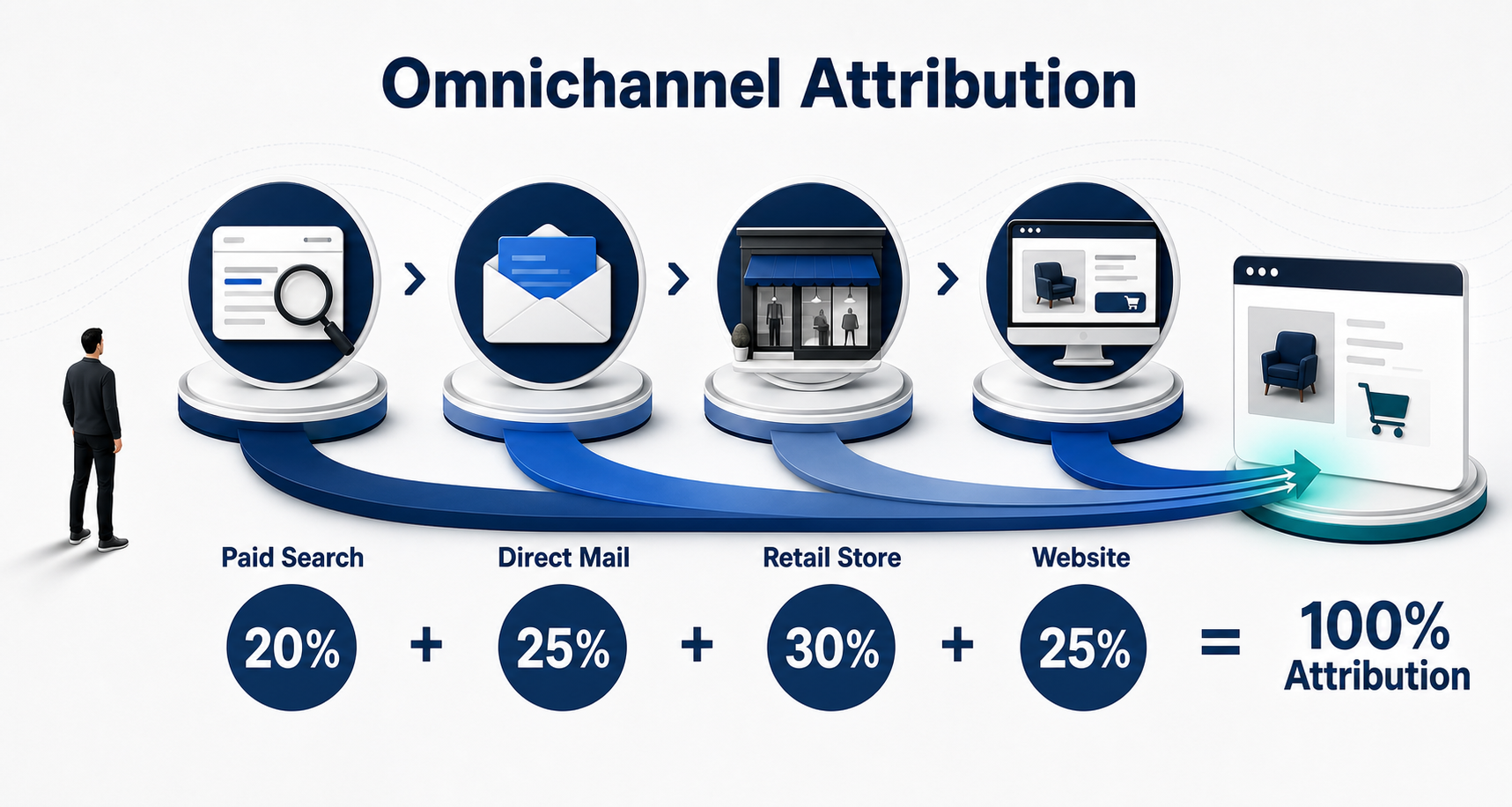
The website may close the sale, but the channels that influenced it must share the credit.
Test every model against behavior. Does a high-value segment generate higher margins, stronger retention, or more future revenue? Do lead scores predict conversion? Do at-risk customers reduce activity or leave? The goal is not perfect data, but data consistent and complete enough for a defined decision, within limits leaders understand.
Turn Customer Knowledge Into Allowable Economics
Customer knowledge proves its value when it improves an economic decision.
Direct Response marketers have long used allowable cost: the maximum the company permits a campaign to spend to produce a sale or a consistently defined qualified lead while still meeting its financial goal. The company may track actual cost per sale (CPS) or cost per lead (CPL). Those results can change as the audience, channel, channel mix, offer, or execution changes. The allowable does not. Once leadership sets it for a defined product or service level and financial objective, it remains the fixed economic ceiling while the campaign is being built and evaluated. The same discipline applies to an initial sale, an upsell, or an added product.
Suppose a new customer produces $1,000 in first-year revenue. That does not reveal what the company can afford to spend. Leaders must consider gross margin, fulfillment, sales expense, returns, service, payment timing, retention, and payback. Without that knowledge, management is unlikely to respect marketing's guidance.
If contribution after variable costs is $250 and the company requires $100 in first-year profit, the allowable acquisition cost is $150. Evidence of later contribution may justify a larger upfront investment. But that choice should draw on input from every relevant department, with marketing managing the customer view. It must account for cash flow, time, and risk—not merely promise lifetime value.
If contribution after variable costs is $250 and the company requires $100 in first-year profit, the allowable cost per sale is $150. The campaign's actual CPS may rise or fall as marketing changes its inputs and execution; the allowable remains $150. A different product or service level may have a different allowable because its margin and cost structure differ. Leadership may also reset the allowable before a future campaign if the underlying economics or financial objective changes. But marketing should not move the allowable while building or evaluating a campaign to accommodate a name, segment, channel, or channel mix. The decision should draw on input from every relevant department, with marketing managing the customer view. It must account for cash flow, time, and risk—not merely promise lifetime value.
That is a better discussion than whether the marketing budget should rise or fall by an arbitrary percentage.
The power of the allowable is that it stabilizes the entire corporate selling apparatus. Direct mail, email, paid search, the website, a retail store, a sales force, or an omnichannel combination all face the same fixed economic ceiling for the same product or service level. Their actual CPS, actual CPL, and attribution shares may differ; the allowable does not. This keeps weaker performance from being excused by changing the standard.
What changes is the value of the name and the campaign's measured performance, not the allowable. If the allowable cost per sale is $150 and one list produces one sale for every 100 names, each name can support up to $1.50 in selling cost. If another produces two sales for every 100 names, each name can support up to $3.00. The allowable per sale remains $150. Better customer knowledge shows which names, segments, channels, and combinations can perform within that fixed ceiling—and where the company should invest or pull back.
Earn the Seat at the Leadership Table
Marketing often asks for a seat at the leadership table as if the function deserves one by virtue of its title. A lasting seat is earned by improving enterprise decisions.
That means moving beyond activity reports. Impressions, clicks, inquiries, engagement, and response are clues, not business outcomes. Leaders need to know which customers the company acquires, what they are worth, how quickly the investment is recovered, why customers stay or leave, and where profitable growth lies.
Marketing sees the messages customers respond to, the problems they want solved, the offers they value, the objections that stop them, and the experiences that shape the relationship. Marketers should also ask customers why they purchased, why they canceled, and what value they found. Empathy sharpens intuition, but it must remain grounded in observed behavior.
Access to signals is not the same as knowledge. Knowledge comes from clear definitions, validated data, defensible attribution, a link between behavior and economics, tested assumptions, and action based on what the company learns.
At that level, marketing becomes a source of business intelligence. It helps finance forecast return, operations see what shapes retention, sales separate volume from value, and the CEO find advantage—or see where growth hides weak economics.
The question is not whether the company owns a CRM or collects a great deal of data. It is whether it can turn customer behavior into decisions that raise enterprise value.
At Fox Photo, the transactions told a story. The report lost credibility because the team could not explain one surprising chapter. Marketing must understand the raw counts well enough to answer a skeptical executive, not merely repeat a summary table.
Your marketing team has the same opportunity. It should know more about your customers than anyone else—not by possessing more data, but by becoming the voice of the customer and helping the company decide whom to serve, what to offer, how much to invest, and where profitable growth will come from next.